Hot Articles
Popular Tags
Which vibration-resistant fasteners fit aerospace use?
For most aerospace applications, the short answer is this: the best vibration-resistant fasteners are not defined by one “magic” product type, but by the combination of locking method, material, certification path, and joint design. In practice, aerospace buyers and engineers typically evaluate prevailing torque locknuts, all-metal self-locking nuts, safety wire-compatible bolts, wedge-locking systems used in approved non-flight-critical areas, and specialty aerospace fasteners built to NAS, MS, AS, or OEM standards. The right choice depends on temperature, vibration spectrum, maintenance interval, weight targets, and whether the fastener is intended for primary structure, engine-adjacent assemblies, avionics, interiors, or ground-support equipment.
For procurement teams, distributors, and technical evaluators, the key issue is not simply “which fastener resists loosening,” but “which fastening solution can prove compliance, repeatability, and lifecycle reliability under aerospace conditions.” That means looking beyond catalog claims and into standards traceability, lot control, material pedigree, testing evidence, and supplier process maturity.
What aerospace buyers usually mean by “vibration-resistant fasteners”
When users search for vibration-resistant fasteners for aerospace, they are usually trying to answer one of four practical questions:
- Which fastener types are actually accepted in aerospace environments?
- Which locking methods work under high vibration, thermal cycling, and fatigue stress?
- What standards or certifications should procurement verify before sourcing?
- How can they reduce loosening risk without creating maintenance, inspection, or compliance problems?
In aerospace, vibration resistance is not just about preventing rotation. A suitable fastener must also maintain clamp load, resist fatigue, avoid galling or hydrogen embrittlement risks where relevant, and remain inspectable and serviceable. In many assemblies, the joint’s performance matters more than the fastener in isolation.
Which fastener types are commonly used for aerospace vibration resistance?
The most suitable options vary by application, but the following categories are the most relevant in aerospace decision-making.
1. All-metal prevailing torque locknuts
These are among the most common choices for high-vibration and elevated-temperature aerospace environments. Unlike nylon-insert locknuts, all-metal designs maintain locking performance better at higher temperatures and in chemically aggressive settings.
Best fit: engine-adjacent assemblies, structural joints, high-temperature zones, and applications where polymer inserts are not acceptable.
Advantages:
- Good resistance to loosening under vibration
- Better temperature capability than non-metallic insert designs
- Well established in aerospace and defense specifications
Procurement caution: verify prevailing torque range, reusability limits, lubrication condition, and exact standard conformance.
2. Self-locking nuts built to aerospace standards
Many aerospace programs rely on self-locking nuts designed to NAS, MS, or equivalent standards. These can include all-metal and non-metallic locking variants, but for critical aerospace use, temperature and certification often narrow the acceptable range.
Best fit: airframe assemblies, access panels, subsystems, and controlled maintenance environments where approved specifications exist.
Advantages:
- Strong standardization and interchangeability
- Good documentation support for qualification and sourcing
- Easier alignment with aerospace MRO and OEM requirements
3. Castellated nuts with cotter pins or drilled fasteners with safety wire
These are classic positive locking methods still used where visual security and mechanical retention are essential. They do not rely only on friction; they physically prevent complete rotation or separation.
Best fit: control systems, wheel systems, critical rotating assemblies, and applications specifically designed for mechanical locking.
Advantages:
- Highly trusted in critical applications
- Easy visual inspection in many maintenance settings
- Low dependence on friction-only locking
Trade-off: installation labor can be higher, and joint design must accommodate the locking hardware.
4. Lockbolts and swaged fastening systems
For permanent or semi-permanent joints, lockbolts can offer excellent vibration resistance and strong clamp retention. They are widely used in aerospace structures and high-load joints where repeatable installation is important.
Best fit: structural assemblies, high-cycle fatigue environments, and production lines seeking consistent installed performance.
Advantages:
- Strong clamp force consistency
- Good fatigue and vibration performance
- Reduced risk of conventional nut loosening
Trade-off: removal and maintenance can be more complex than with standard threaded fasteners.
5. Wedge-locking washers and specialty anti-loosening systems
These systems are well known in industrial vibration control, but aerospace suitability depends heavily on the exact application and approval pathway. They may be more common in non-flight-critical assemblies, interiors, support equipment, or certain approved subsystem uses rather than across all primary aerospace joints.
Best fit: selected approved assemblies, support structures, non-primary systems, and ground-support or industrial aerospace-adjacent equipment.
Advantages:
- Strong anti-loosening behavior under transverse vibration
- Useful where maintenance simplification is a goal
- Can perform well when joint geometry and preload are controlled
Procurement caution: do not assume industrial anti-vibration performance automatically equals aerospace approval.
Which options are usually less suitable for demanding aerospace use?
Buyers should be careful with solutions that perform well in general industry but may be restricted in aerospace.
- Standard nylon-insert locknuts: often limited by temperature, fluid exposure, aging, and some certification constraints.
- Generic threadlockers without aerospace approval: may lack outgassing, temperature, traceability, or process control acceptance.
- Commercial-grade fasteners with no aerospace pedigree: even if strength values look acceptable, documentation and process integrity may not be.
- Mixed-material combinations without galvanic review: can create corrosion and long-term reliability issues.
In short, aerospace sourcing should avoid “looks equivalent” substitutions unless the design authority explicitly approves them.
How should procurement teams judge fit for aerospace applications?
For target readers such as sourcing specialists, commercial evaluators, and distributors, the most useful approach is a structured screening model. Instead of asking only whether a fastener is vibration resistant, ask whether it is fit for the exact aerospace environment.
Check 1: Application criticality
- Primary structure or secondary structure?
- Flight-critical or non-flight-critical?
- Interior, avionics, airframe, engine bay, landing system, or support equipment?
The higher the criticality, the stronger the requirement for proven aerospace standards, qualification evidence, and design authority approval.
Check 2: Temperature and environmental exposure
- Will the joint see high heat?
- Is there exposure to fuel, hydraulic fluid, salt fog, or de-icing chemicals?
- Will thermal cycling reduce clamp load or affect insert materials?
This is why all-metal locking solutions often outperform polymer-based options in harsh aerospace zones.
Check 3: Fatigue and vibration profile
- Is the vibration continuous, intermittent, or shock-based?
- Is the assembly subject to transverse movement?
- Will preload relaxation be a bigger issue than rotational loosening?
A fastener that survives static load is not automatically suitable for high-cycle vibration exposure.
Check 4: Material compatibility
- Titanium, alloy steel, stainless steel, Inconel, or aluminum-compatible?
- Any galling risk?
- Any galvanic corrosion concern with the mating materials?
Material selection often matters as much as locking method, especially in lightweight aerospace designs.
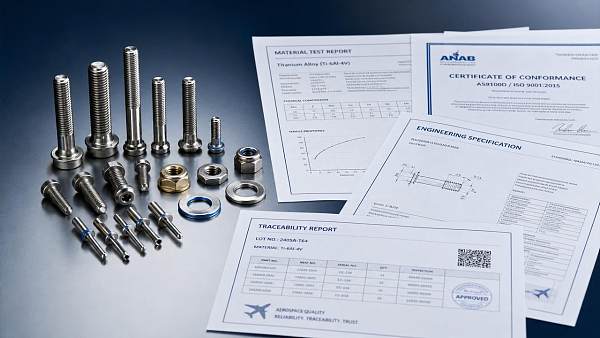
Check 5: Standards and traceability
Procurement should confirm:
- Applicable NAS, MS, AS, MIL, ISO, or OEM standards
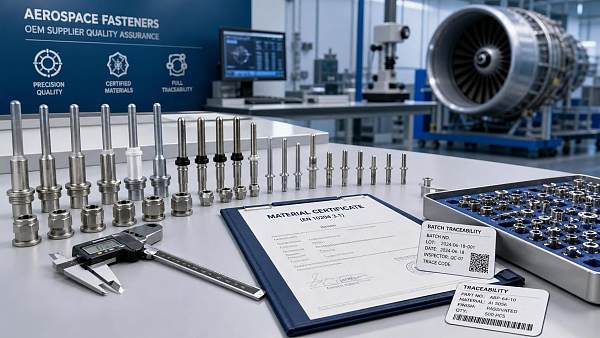
- Heat lot and material certificates
- Dimensional and mechanical property reports
- Plating, coating, and process certifications
- Full batch traceability and counterfeit-risk controls
This is where many purchasing risks appear. A technically good fastener with weak traceability can still be a poor aerospace purchase.
What standards and documents matter most?
The exact documents vary by platform and region, but aerospace fastener sourcing commonly revolves around:
- NAS, MS, and AS standards
- OEM or Tier-1 approved parts lists
- Material certifications and mill test reports
- AS9100-related quality system expectations at supplier level
- Special process documentation for plating, heat treatment, lubrication, and inspection
- First article inspection or PPAP-like documentation where contractually required
For business evaluators, the practical takeaway is simple: a fastener should not be judged only by tensile strength or locking style. It should be judged by its ability to pass customer audit, incoming inspection, and long-term field reliability review.
How to compare suppliers of vibration-resistant aerospace fasteners
When multiple suppliers offer apparently similar products, decision-makers should compare them using both technical and commercial criteria.
Technical comparison points
- Conformance to exact aerospace standard, not just “equivalent” claims
- Availability of high-temperature and vibration test data
- Surface finish, coating, lubrication, and torque consistency
- Lot traceability and counterfeit prevention controls
- Dimensional consistency and thread quality
Commercial comparison points
- Lead time stability
- Dual-source availability
- Raw material risk exposure for titanium, nickel, and alloy steel
- Export control or cross-border compliance capability
- After-sales technical support and nonconformance response speed
For buyers managing Industrial Procurement across global programs, resilience is part of product fitness. A technically correct fastener with unstable supply may still create program risk.
In some sourcing workflows, teams also map internal reference items or approved alternatives through digital catalogs such as 无, but any listing should still be validated against aerospace approval, revision control, and contract requirements before release.
Best choice by application scenario
Here is a practical summary for faster decision-making:
- High-temperature aerospace zones: all-metal prevailing torque locknuts or other approved metallic locking systems
- Critical joints needing positive retention: castellated nuts, cotter-pin systems, or safety-wire-compatible designs
- Structural production assemblies: lockbolts or engineered permanent fastening systems
- Serviceable access points with approved standards: aerospace self-locking nuts and matched bolts
- Non-primary or support applications: specialty anti-loosening systems, if explicitly suitable and approved
If a buyer wants a general rule, this is the safest one: for true aerospace use, choose fasteners with established aerospace standardization and traceability first; consider specialty anti-vibration technologies only after confirming design acceptance and certification fit.
Common mistakes that increase aerospace fastener risk
- Buying by unit price instead of total reliability
- Using industrial-grade substitutes without formal approval
- Ignoring installation torque, lubrication state, and preload control
- Assuming all locking nuts are reusable in the same way
- Overlooking corrosion pairing and coating compatibility
- Failing to align supplier documentation with customer audit expectations
These mistakes often cost more in inspection delays, quality escapes, or maintenance burden than any initial price saving.
Final assessment: which vibration-resistant fasteners fit aerospace use?
The best aerospace-fit vibration-resistant fasteners are typically all-metal self-locking nuts, prevailing torque locknuts, safety-wire or cotter-pin-secured systems, and lockbolt-style structural fasteners—provided they meet the exact aerospace standard, material, and documentation requirements of the application. Specialty anti-loosening systems may also be useful in selected approved cases, but they should never be treated as automatic substitutes for established aerospace hardware.
For procurement professionals and market evaluators, the right decision framework is clear: prioritize application criticality, qualification evidence, material compatibility, traceability, and supply-chain resilience. In aerospace, a fastener is not just a component; it is a reliability control point. The sourcing teams that treat it that way make better technical and commercial decisions.
Recommended News
 Oct 12, 2026How to Specify Low-VOC Fastener Coatings for Corrosion Protection and ComplianceLow VOC fastener coating specification guide: balance corrosion resistance, torque control, VOC compliance, and supplier validation for reliable assemblies.● Dr. Aris Alloy
 Oct 08, 2026Selecting Precision Fasteners for Semiconductor Equipment Vacuum and Cleanroom ServicePrecision Fasteners for semiconductor equipment: learn how to select vacuum- and cleanroom-ready hardware for reliable preload, low contamination, and long-term serviceability.● Dr. Aris Alloy
 Oct 04, 2026Selecting Stainless Micro Screws for Corrosion Resistance and Precision AssemblyStainless micro screws guide: choose corrosion-resistant alloys, precision threads, and reliable drive designs for demanding assemblies. Explore key selection tips.● Dr. Aris Alloy
 Oct 04, 2026How Do You Verify Precision Fastener Tolerances From a Datasheet?How do I verify precision fastener tolerances from a datasheet? Learn the key checks for thread class, dimensions, coatings, materials, and inspection methods.● Dr. Aris Alloy
 Sep 15, 2026Selecting Threaded Rods for Construction: Load, Corrosion, and Code RequirementsThreaded rods for construction: learn how to match load paths, corrosion protection, installation details, and code requirements for safer, compliant connections.● Dr. Aris Alloy
 Aug 16, 2026What Makes a High Strength Alloy Suitable for Aerospace Parts?High strength alloy for aerospace selection depends on more than tensile strength. Learn how fatigue, corrosion, heat, and manufacturability determine safer, lighter parts.● Dr. Aris Alloy
 Jul 26, 2026How Strong Are 3D Printed Fasteners in Load-Bearing Assemblies?3d printed fastener strength explained for load-bearing assemblies: learn where printed bolts work, where they fail, and how to choose safer, smarter fastening options.● Dr. Aris Alloy
 Jul 22, 2026How to Evaluate a Blind Bolt Custom OEM Partner for Aerospace Fastener ProjectsBlind bolt custom OEM sourcing for aerospace demands more than price. Learn how to assess quality systems, material traceability, engineering support, and supply stability before choosing a partner.● Dr. Aris Alloy
 Jul 18, 2026Salt Spray Hours for Fasteners: How to Compare Coatings and Corrosion ResistanceSalt spray hours fasteners explained: compare coatings, test limits, and real corrosion resistance to choose the right finish for longer service life and smarter sourcing.● Dr. Aris Alloy
 Jul 15, 2026Precision Fasteners Cost Factors: Materials, Tolerances, Finishes, and Order VolumePrecision Fasteners cost factors explained: compare materials, tolerances, finishes, and order volume to reduce sourcing risk, control total cost, and make smarter buying decisions.● Dr. Aris Alloy
 Jul 14, 2026How to Read a Titanium Alloy Weight Chart for Fastener and Aerospace Part SelectionTitanium alloy weight chart guide for fastener and aerospace part selection. Learn how to compare grade, density, dimensions, and standards to reduce sourcing risk.● Dr. Aris Alloy
 Jul 12, 2026How to Read Fastener Vibration Test Data for Joint Reliability DecisionsFastener vibration test data explained for smarter joint reliability decisions. Learn how to assess preload loss, residual clamp load, and test validity before sourcing or design approval.● Dr. Aris Alloy
 Jul 09, 2026Fastener Coating Cost Breakdown: What Changes Price by Material, Finish, and VolumeFastener coating cost explained: see how material, finish, volume, geometry, and compliance affect pricing, and learn how to compare quotes smarter while controlling total sourcing cost.● Dr. Aris Alloy
 Jul 06, 2026Self Tapping Industrial Screws: Types, Materials, and When to Use EachSelf tapping Industrial Screws guide: compare thread-forming, thread-cutting, and self-drilling types, materials, and best-use scenarios to choose faster, stronger, more reliable assemblies.● Dr. Aris Alloy
 Jul 05, 2026High-Tensile Bolts ASTM: How to Read Grades, Strength Classes, and Spec RequirementsHigh-Tensile Bolts ASTM guide: learn how to read grades, strength classes, specs, markings, and certificates to avoid sourcing mistakes and choose compliant bolts with confidence.● Dr. Aris Alloy
 Jul 04, 2026Stainless Automotive Fasteners Manufacturer: What Certifications and Materials Matter Most?Stainless automotive fasteners manufacturer selection starts with certifications, traceability, and the right alloys. Learn what matters most for reliable, compliant sourcing.● Dr. Aris Alloy
 Jul 03, 2026Fastener Price Trend 2026: What Steel Costs, Freight, and Demand Mean for BuyersFastener price trend 2026 explained: see how steel costs, freight volatility, and uneven demand may affect budgets, lead times, and sourcing decisions—so buyers can plan smarter.● Dr. Aris Alloy
 Jul 02, 2026Why Smart Fastener Battery Life Drops Early and How to Extend Service IntervalsSmart fastener battery life dropping too soon? Learn the real causes behind early drain and discover practical ways to extend service intervals without sacrificing monitoring accuracy.● Dr. Aris Alloy
 Jun 28, 2026Marine Grade Stainless Corrosion: What Causes It and How to Prevent Tea StainingMarine grade stainless corrosion often starts with tea staining. Learn the real causes, high-risk environments, and practical prevention steps to protect performance and cut lifecycle costs.● Dr. Aris Alloy
 Jun 26, 2026How to Choose Vibration-Resistant Fasteners for Aerospace AssembliesVibration-Resistant Fasteners for aerospace help protect critical assemblies from loosening, corrosion, and fatigue. Learn how to choose the right solution for safer, longer-lasting performance.● Dr. Aris Alloy
 Jun 23, 2026Fastener Hardness Explained: When to Use Rockwell vs Vickers TestingFastener hardness (Rockwell/Vickers) explained: learn when to use Rockwell for fast production checks and Vickers for precise surface analysis to improve quality, compliance, and reliability.● Dr. Aris Alloy
 Jun 15, 2026Wholesale Aerospace Fasteners: Specs, Materials, and Certifications Buyers Should CheckWholesale aerospace fasteners buyers should verify specs, material traceability, and certifications before ordering. Learn the key checks to reduce risk and source with confidence.● Dr. Aris Alloy
 Jun 07, 2026Instrument Cases Buying Guide: Hard vs Soft Cases, Protection Ratings, and FitInstrument cases buying guide: compare hard vs soft cases, understand IP protection ratings, and choose the right fit to protect sensitive equipment, reduce downtime, and buy with confidence.● Dr. Aris Alloy
 Jun 06, 2026How Global Construction Fastener Tenders Work: Bid Requirements, Specs, and Common RisksGlobal construction fastener tenders explained: learn bid requirements, key specs, compliance checks, and common risks to improve tender decisions and avoid costly project delays.● Dr. Aris Alloy