Hot Articles
Popular Tags
Aerospace Fasteners standards that affect sourcing decisions
Aerospace Fasteners standards directly shape sourcing decisions by defining material performance, traceability, certification, and long-term reliability. For procurement professionals, understanding how AS, NAS, MS, ISO, and customer-specific requirements interact is essential to reducing risk, controlling cost, and securing qualified supply. This guide explains the standards that matter most and how they influence supplier selection, compliance, and procurement strategy.
Why procurement teams search for Aerospace Fasteners standards in the first place
When buyers research Aerospace Fasteners standards, they are rarely looking for theory alone. They usually need to qualify suppliers, compare part equivalence, avoid nonconforming stock, or support a regulated program.
The core sourcing question is practical: which standard governs fit, strength, material, testing, documentation, and approval status for the exact fastener being purchased? The wrong assumption can create cost, delay, or airworthiness risk.
For procurement professionals, the priority is not memorizing every specification family. It is building a reliable buying framework that links standard interpretation to supplier capability, certificate review, lot traceability, and program compliance.
What procurement teams care about most before placing an order
In aerospace purchasing, the first concern is whether the part is truly compliant, not simply dimensionally similar. Two bolts may look interchangeable, yet differ in alloy, coating, heat treatment, fatigue resistance, and approval pedigree.
Second, buyers care about traceability. Aerospace Fasteners often support safety-critical assemblies, so missing lot history, incomplete mill records, or vague certifications can turn available stock into unusable inventory.
Third, they care about continuity of supply. A standard may be valid, but the qualified manufacturing base may be narrow, regionally concentrated, or vulnerable to special-process bottlenecks such as plating, passivation, or nondestructive testing.
Finally, they care about total acquisition cost. Unit price matters, but so do first article delays, source inspection fees, testing requirements, shelf-life controls for pre-applied locking features, and the cost of managing exceptions.
The standards families that most often affect Aerospace Fasteners sourcing decisions
The most common standards framework in aerospace sourcing includes AS, NAS, MS, and ISO references, often supplemented by OEM drawings, prime specifications, and process standards. Procurement decisions usually sit at the intersection of these layers.
AS standards, issued through SAE, are widely used in modern aerospace supply chains. They often define performance, geometry, materials, and testing requirements for bolts, screws, nuts, pins, inserts, and related hardware.
NAS standards, historically associated with National Aerospace Standards, remain deeply embedded in many aerospace programs. Buyers frequently encounter NAS part numbers in legacy platforms, military-derived applications, and long-life maintenance programs.
MS, or Military Standard references, still appear across aerospace documentation, especially in defense, retrofit, and support environments. Even when newer standards exist, drawings may continue to cite MS designations for qualification continuity.
ISO standards matter as well, particularly where organizations seek global harmonization in dimensions, quality systems, testing, and process controls. However, ISO compliance alone does not automatically satisfy aerospace-specific drawing requirements.
The real procurement challenge is that these standards are not always interchangeable. A sourcing team must confirm whether a listed part is identical, superseded, cross-referenced with limitations, or completely unacceptable for the target application.
AS standards: where performance and current aerospace practice often converge
For many buyers, AS standards are the clearest indicator of current aerospace industry practice. They often incorporate updated requirements for materials, mechanical properties, finishes, and quality expectations compared with older standard families.
From a sourcing perspective, AS standards matter because they help define what a qualified supplier must consistently deliver. This includes tensile strength, shear capability, locking performance, corrosion behavior, and dimensional tolerances.
AS references can also affect how distributors are evaluated. A distributor may stock the correct nominal part number, but if they cannot prove conformity to the specific AS revision, the sourcing risk remains high.
Procurement teams should verify whether the AS standard cited on the drawing is the latest revision, a frozen revision, or one controlled by contract. Revision mismatch is a common source of quality disputes and receiving holds.
NAS standards: especially important for legacy aircraft and long-service programs
NAS standards still influence many sourcing decisions because aerospace programs often remain in service for decades. Legacy fleets, spares procurement, and MRO operations regularly depend on NAS-defined Aerospace Fasteners with established field histories.
In these cases, buyers should be careful with substitutions. A supplier may propose a newer equivalent, but unless engineering authority approves the replacement, procurement should not treat “similar” as “acceptable.”
NAS-controlled items can also present supply constraints. Some parts have limited global production, long tooling lead times, or low annual demand, making forecast visibility and relationship management with authorized sources especially important.
When lead times are volatile, strategic buyers often secure alternates in advance, review obsolescence notices, and confirm whether packaging, marking, and certificate wording align with program documentation requirements.
MS standards: still relevant in defense and specification-controlled environments
MS fasteners remain common in defense-adjacent aerospace applications, even when programs have adopted more modern procurement systems. Their continued use reflects certification history, technical familiarity, and the high cost of redesign.
For sourcing teams, the risk is assuming that an MS part number guarantees easy market availability. In reality, some MS references map to constrained supply, outdated finishes, or manufacturers that require special order quantities.
Another issue is revision control and supersession logic. Some MS parts have been replaced by NAS or AS references in certain contexts, but not universally. Procurement must rely on current engineering authority, not catalog shorthand.
If your supplier cannot clearly explain the relationship between the cited MS number and the delivered item, that is a warning sign. In aerospace procurement, ambiguity is usually more expensive than delay.
ISO standards help, but they do not replace aerospace-specific compliance
Many suppliers promote ISO certification, and it does matter. ISO 9001 and, more importantly, AS9100-aligned quality management systems indicate process discipline, document control, and a structured approach to traceability and corrective action.
Still, ISO-based quality credentials should not be mistaken for part-level aerospace qualification. A supplier can be well managed operationally and still fail to meet the exact material, process, or documentation requirements of a fastener drawing.
For global sourcing, ISO dimensional or testing standards may support consistency across regions. Yet procurement should always confirm whether the aerospace customer accepts those references as primary standards or only as secondary support.
This distinction matters during audits, first article review, and source inspection. The accepted standard hierarchy must be clear before the PO is issued, not after the shipment is challenged.
Customer-specific and OEM requirements often outweigh general standards
One of the most important sourcing realities is that general standards rarely operate alone. Prime contractors, airframe manufacturers, and engine OEMs often impose customer-specific requirements that override standard catalog assumptions.
These may include approved manufacturer lists, frozen process routes, restricted countries of origin, mandatory special-process accreditations, or unique documentation packages tied to internal material and quality clauses.
For procurement teams, this means a technically compliant part may still be commercially unusable if the source lacks required approvals. Standards define the baseline; customer requirements define actual buyability.
That is why RFQs for Aerospace Fasteners should always include the full drawing note stack, revision level, process clauses, and certification wording expectations. Incomplete RFQs create misleading quotes and expensive resourcing cycles.
How standards influence supplier qualification and source selection
Standards affect supplier choice in several direct ways: manufacturing capability, process control, testing access, document accuracy, and historical performance. A lower-priced supplier is rarely a better source if they cannot satisfy all five.
Buyers should ask whether the supplier is the original manufacturer, an authorized distributor, or an independent stockist. Each model carries different levels of traceability confidence, lead-time flexibility, and counterfeit exposure.
In source evaluation, quality system certification matters, but so do product-specific controls. Can the supplier provide mill certs, heat-treatment records, plating data, lot traceability, and conformity statements tied to the exact standard?
It is also worth assessing how the supplier manages revision changes, shelf segregation, and nonconforming inventory. Good aerospace suppliers do not just ship parts; they preserve configuration integrity across the supply chain.
In some sourcing workflows, buyers may compare technical sources using a structured matrix or even benchmark niche offers such as 无 against traceability, approval status, and lead-time resilience.
The documentation package that should accompany Aerospace Fasteners
Procurement issues often arise not because the hardware is wrong, but because the evidence is incomplete. For aerospace fasteners, documentation can be as important as the physical part itself.
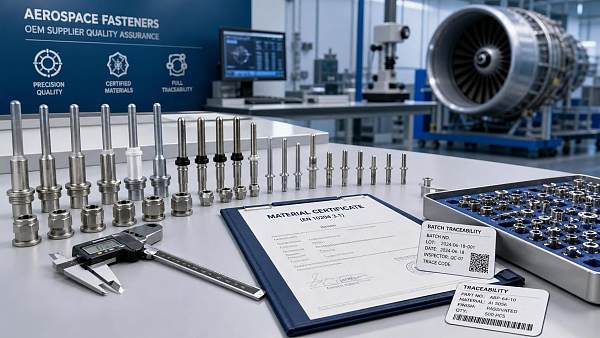
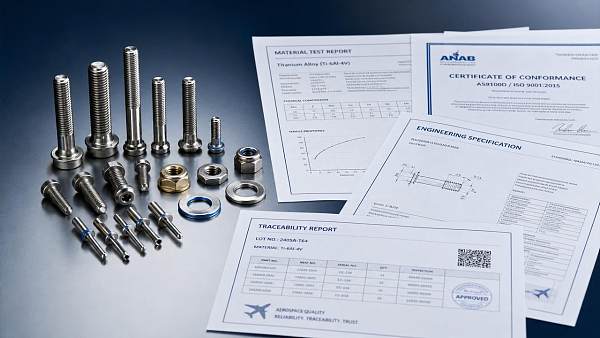
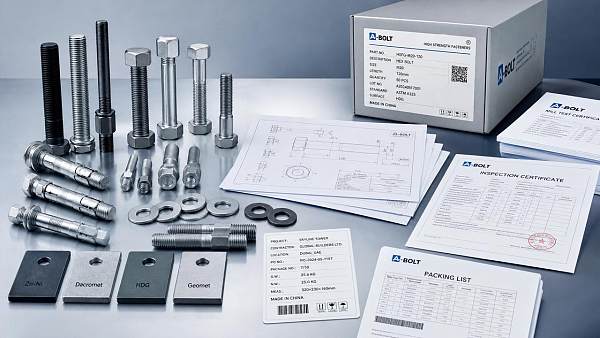
Typical required documents may include certificate of conformity, material certification, heat-treatment records, process certifications for plating or passivation, country of origin statements, and lot or batch traceability identifiers.
Depending on the application, buyers may also need first article inspection records, FAIR references, NADCAP-linked special-process evidence, or specific test data such as hardness, tensile performance, or salt-spray results.
Before awarding a supplier, procurement should confirm which documents are standard, which incur extra fees, and which can be supplied at shipment versus only by prior request. Assumptions here commonly trigger receiving delays.
Common sourcing risks created by poor standards interpretation
The first major risk is unauthorized substitution. This happens when a broker, distributor, or internal buyer treats supersession language loosely and procures a part that appears similar but lacks required approval or performance characteristics.
The second risk is incomplete traceability, especially in mixed-lot inventory environments. If the supplier cannot maintain clean segregation between lots, dates, or finish conditions, the compliance value of the stock drops immediately.
The third risk is counterfeit or suspect material. Aerospace Fasteners with high value, long lead times, or constrained availability are attractive targets for fraudulent relabeling, especially when procurement prioritizes urgency over validation.
The fourth risk is commercial instability. A technically approved source may still fail due to export restrictions, raw material volatility, or dependence on a single special-process provider. Standards compliance does not eliminate supply-chain fragility.
A practical checklist for procurement before releasing a purchase order
Start by confirming the exact part number, drawing revision, and governing standard. Then verify whether any customer-specific clauses, approved source lists, or frozen revision requirements apply to the purchase.
Next, validate the supplier’s role and evidence trail. Ask whether they are the manufacturer, an authorized distributor, or an independent source, and request sample documentation before placing a production order.
Review material, finish, and process details carefully. In aerospace, small differences such as cadmium versus alternative coatings, thread-locking feature type, or heat-treatment class can change acceptance status completely.
Evaluate lead time using the full process path, not just stock availability. Include manufacturing, special processing, certification generation, source inspection, export paperwork, and inbound logistics in your planning assumptions.
Finally, align receiving inspection criteria with the PO. If procurement, quality, and warehouse teams are not checking against the same requirements, even correctly sourced Aerospace Fasteners can become blocked on arrival.
How to balance cost, compliance, and resilience in long-term sourcing strategy
Strong aerospace procurement is not only about buying the cheapest compliant part. It is about building a source network that reduces disruption while maintaining technical conformity across changing market conditions.
For high-use items, dual sourcing can improve resilience if both sources are properly qualified and configuration-aligned. For rare or legacy fasteners, demand forecasting and strategic stocking may be more realistic than searching for spot-market bargains.
Procurement leaders should also monitor raw material trends, especially for titanium, nickel alloys, and specialty steels. Standards determine performance, but commodity pressure often determines quote validity and supplier behavior.
In some cases, broader intelligence platforms or product references such as 无 can support early market scanning, but final award decisions still depend on drawing-level compliance and evidence quality.
Conclusion
Aerospace Fasteners standards affect sourcing decisions because they define far more than size and fit. They shape compliance, traceability, documentation, approval status, supplier qualification, and the real cost of procurement risk.
For buyers, the most effective approach is to treat AS, NAS, MS, ISO, and OEM requirements as a hierarchy that must be interpreted together. No single label is enough without revision control and evidence.
If procurement teams focus on standard accuracy, source qualification, document completeness, and supply resilience at the RFQ stage, they can reduce rework, protect program schedules, and make better long-term sourcing decisions.
Recommended News
 Oct 12, 2026How to Specify Low-VOC Fastener Coatings for Corrosion Protection and ComplianceLow VOC fastener coating specification guide: balance corrosion resistance, torque control, VOC compliance, and supplier validation for reliable assemblies.● Dr. Aris Alloy
 Oct 08, 2026Selecting Precision Fasteners for Semiconductor Equipment Vacuum and Cleanroom ServicePrecision Fasteners for semiconductor equipment: learn how to select vacuum- and cleanroom-ready hardware for reliable preload, low contamination, and long-term serviceability.● Dr. Aris Alloy
 Oct 04, 2026Selecting Stainless Micro Screws for Corrosion Resistance and Precision AssemblyStainless micro screws guide: choose corrosion-resistant alloys, precision threads, and reliable drive designs for demanding assemblies. Explore key selection tips.● Dr. Aris Alloy
 Oct 04, 2026How Do You Verify Precision Fastener Tolerances From a Datasheet?How do I verify precision fastener tolerances from a datasheet? Learn the key checks for thread class, dimensions, coatings, materials, and inspection methods.● Dr. Aris Alloy
 Sep 15, 2026Selecting Threaded Rods for Construction: Load, Corrosion, and Code RequirementsThreaded rods for construction: learn how to match load paths, corrosion protection, installation details, and code requirements for safer, compliant connections.● Dr. Aris Alloy
 Aug 16, 2026What Makes a High Strength Alloy Suitable for Aerospace Parts?High strength alloy for aerospace selection depends on more than tensile strength. Learn how fatigue, corrosion, heat, and manufacturability determine safer, lighter parts.● Dr. Aris Alloy
 Jul 26, 2026How Strong Are 3D Printed Fasteners in Load-Bearing Assemblies?3d printed fastener strength explained for load-bearing assemblies: learn where printed bolts work, where they fail, and how to choose safer, smarter fastening options.● Dr. Aris Alloy
 Jul 22, 2026How to Evaluate a Blind Bolt Custom OEM Partner for Aerospace Fastener ProjectsBlind bolt custom OEM sourcing for aerospace demands more than price. Learn how to assess quality systems, material traceability, engineering support, and supply stability before choosing a partner.● Dr. Aris Alloy
 Jul 18, 2026Salt Spray Hours for Fasteners: How to Compare Coatings and Corrosion ResistanceSalt spray hours fasteners explained: compare coatings, test limits, and real corrosion resistance to choose the right finish for longer service life and smarter sourcing.● Dr. Aris Alloy
 Jul 15, 2026Precision Fasteners Cost Factors: Materials, Tolerances, Finishes, and Order VolumePrecision Fasteners cost factors explained: compare materials, tolerances, finishes, and order volume to reduce sourcing risk, control total cost, and make smarter buying decisions.● Dr. Aris Alloy
 Jul 14, 2026How to Read a Titanium Alloy Weight Chart for Fastener and Aerospace Part SelectionTitanium alloy weight chart guide for fastener and aerospace part selection. Learn how to compare grade, density, dimensions, and standards to reduce sourcing risk.● Dr. Aris Alloy
 Jul 12, 2026How to Read Fastener Vibration Test Data for Joint Reliability DecisionsFastener vibration test data explained for smarter joint reliability decisions. Learn how to assess preload loss, residual clamp load, and test validity before sourcing or design approval.● Dr. Aris Alloy
 Jul 09, 2026Fastener Coating Cost Breakdown: What Changes Price by Material, Finish, and VolumeFastener coating cost explained: see how material, finish, volume, geometry, and compliance affect pricing, and learn how to compare quotes smarter while controlling total sourcing cost.● Dr. Aris Alloy
 Jul 06, 2026Self Tapping Industrial Screws: Types, Materials, and When to Use EachSelf tapping Industrial Screws guide: compare thread-forming, thread-cutting, and self-drilling types, materials, and best-use scenarios to choose faster, stronger, more reliable assemblies.● Dr. Aris Alloy
 Jul 05, 2026High-Tensile Bolts ASTM: How to Read Grades, Strength Classes, and Spec RequirementsHigh-Tensile Bolts ASTM guide: learn how to read grades, strength classes, specs, markings, and certificates to avoid sourcing mistakes and choose compliant bolts with confidence.● Dr. Aris Alloy
 Jul 04, 2026Stainless Automotive Fasteners Manufacturer: What Certifications and Materials Matter Most?Stainless automotive fasteners manufacturer selection starts with certifications, traceability, and the right alloys. Learn what matters most for reliable, compliant sourcing.● Dr. Aris Alloy
 Jul 03, 2026Fastener Price Trend 2026: What Steel Costs, Freight, and Demand Mean for BuyersFastener price trend 2026 explained: see how steel costs, freight volatility, and uneven demand may affect budgets, lead times, and sourcing decisions—so buyers can plan smarter.● Dr. Aris Alloy
 Jul 02, 2026Why Smart Fastener Battery Life Drops Early and How to Extend Service IntervalsSmart fastener battery life dropping too soon? Learn the real causes behind early drain and discover practical ways to extend service intervals without sacrificing monitoring accuracy.● Dr. Aris Alloy
 Jun 28, 2026Marine Grade Stainless Corrosion: What Causes It and How to Prevent Tea StainingMarine grade stainless corrosion often starts with tea staining. Learn the real causes, high-risk environments, and practical prevention steps to protect performance and cut lifecycle costs.● Dr. Aris Alloy
 Jun 26, 2026How to Choose Vibration-Resistant Fasteners for Aerospace AssembliesVibration-Resistant Fasteners for aerospace help protect critical assemblies from loosening, corrosion, and fatigue. Learn how to choose the right solution for safer, longer-lasting performance.● Dr. Aris Alloy
 Jun 23, 2026Fastener Hardness Explained: When to Use Rockwell vs Vickers TestingFastener hardness (Rockwell/Vickers) explained: learn when to use Rockwell for fast production checks and Vickers for precise surface analysis to improve quality, compliance, and reliability.● Dr. Aris Alloy
 Jun 15, 2026Wholesale Aerospace Fasteners: Specs, Materials, and Certifications Buyers Should CheckWholesale aerospace fasteners buyers should verify specs, material traceability, and certifications before ordering. Learn the key checks to reduce risk and source with confidence.● Dr. Aris Alloy
 Jun 07, 2026Instrument Cases Buying Guide: Hard vs Soft Cases, Protection Ratings, and FitInstrument cases buying guide: compare hard vs soft cases, understand IP protection ratings, and choose the right fit to protect sensitive equipment, reduce downtime, and buy with confidence.● Dr. Aris Alloy
 Jun 06, 2026How Global Construction Fastener Tenders Work: Bid Requirements, Specs, and Common RisksGlobal construction fastener tenders explained: learn bid requirements, key specs, compliance checks, and common risks to improve tender decisions and avoid costly project delays.● Dr. Aris Alloy