Hot Articles
Popular Tags
What matters most when sourcing aerospace fasteners
When sourcing Aerospace Fasteners, procurement teams must look beyond unit price and focus on certification, material traceability, performance under extreme conditions, and supplier consistency. In aerospace programs, even a small fastening component can affect safety, compliance, and lifecycle cost. This article outlines the key factors buyers should evaluate to reduce supply risk and secure reliable, standards-aligned sourcing decisions.
For buyers managing civil aviation, defense, MRO, space, or advanced industrial platforms, the challenge is rarely just availability. The real issue is whether a supplier can provide Aerospace Fasteners with documented conformity, repeatable quality, and stable lead times across multiple production lots.
In fragmented global supply chains, procurement decisions now influence not only purchase cost, but also qualification timelines, audit readiness, and long-term program reliability. A structured sourcing framework helps reduce risk before a missing certificate, a material deviation, or a delayed shipment becomes an operational problem.
Why Aerospace Fasteners Require a Different Sourcing Standard
Aerospace Fasteners are not standard industrial bolts used in low-risk assemblies. They are engineered components designed for high vibration, cyclic loading, pressure variation, temperature extremes, and strict airworthiness expectations. In many assemblies, a single fastener failure can trigger inspection events, downtime, or safety concerns.
Procurement teams typically evaluate at least 4 dimensions: technical compliance, supply continuity, documentation quality, and total lifecycle cost. If one of these areas is weak, the initial price advantage may disappear through rework, delayed approvals, or line stoppages lasting 24 to 72 hours.
Performance conditions are stricter than in general industrial sourcing
Depending on the application, aerospace fasteners may operate in temperature ranges from -55°C to above 200°C, under sustained vibration, or in corrosive environments involving moisture, fuel, hydraulic fluid, or salt exposure. These demands make alloy choice, heat treatment, surface finish, and dimensional consistency critical purchasing factors.
Buyers should also recognize that tensile strength is only one part of the picture. Fatigue resistance, locking performance, thread integrity, and installation repeatability matter just as much, especially in structures that undergo thousands of flight cycles over a 10- to 25-year service life.
Compliance risk is built into the product category
Unlike many commercial fasteners, Aerospace Fasteners often require documented compliance with standards such as NAS, MS, AS, or customer-specific specifications. Missing paperwork, incomplete lot traceability, or unverified substitution can interrupt supplier approval processes and trigger quarantine of incoming material.
For procurement personnel, this means supplier qualification should be treated as a technical-commercial review, not just a quotation exercise. A supplier that responds in 48 hours but cannot support PPAP-like documentation discipline, first article requirements, or lot-level traceability may increase downstream cost.
Typical decision criteria buyers should prioritize
- Material grade suitability for the operating environment
- Traceability from mill source to finished lot
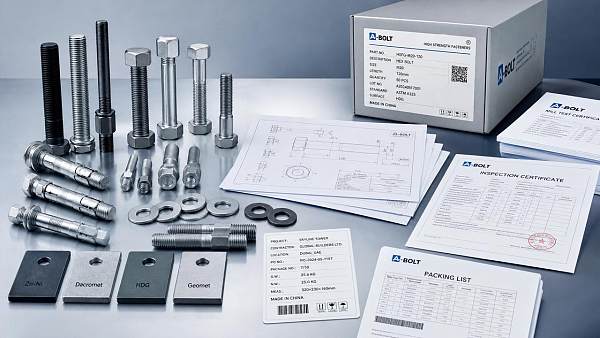
- Availability of test reports and certificates
- Dimensional consistency across repeated orders
- Lead time stability over 8- to 16-week planning windows
- Packaging and preservation controls for export and storage
The table below highlights how sourcing Aerospace Fasteners differs from general-purpose industrial fastener procurement in a practical B2B context.
The key takeaway is clear: a lower quoted price does not automatically mean lower procurement cost. With Aerospace Fasteners, the stronger commercial decision often comes from choosing the supplier that reduces verification effort, quality escapes, and replenishment uncertainty over multiple order cycles.
The 6 Core Factors Procurement Teams Should Evaluate
A disciplined supplier review process helps buyers compare quotes on more than cost. The most effective procurement teams assess at least 6 core factors before awarding contracts for Aerospace Fasteners, especially for long-running programs or regulated supply chains.
1. Certification and standards alignment
Start with the standards the part must meet. Many aerospace buyers require compliance with NAS, MS, AS, or OEM drawing requirements, while the supplier’s quality management framework may be reviewed against aerospace-relevant quality systems. Buyers should confirm whether the quoted part is manufactured to the exact standard, not merely “equivalent.”
If a supplier offers an alternate part number, the procurement team should request a controlled cross-reference, dimensional comparison, material confirmation, and approval route. A 1-to-1 substitution assumption is risky when thread geometry, head style, coating, or locking features differ.
2. Material traceability from source to shipment
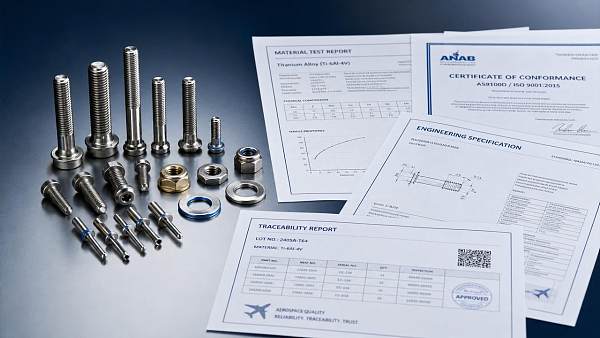
Traceability should extend from raw material heat or melt source through machining, forming, heat treatment, plating, inspection, and final packing. For critical Aerospace Fasteners, lot-level traceability is often non-negotiable because it supports quality containment if a deviation is later identified.
Procurement teams should verify whether the supplier can maintain traceability over at least 7 to 10 years if required by the program or customer contract. In international trade, traceability discipline also helps when shipments cross multiple warehousing or customs points.
3. Mechanical performance and application fit
Not all approved materials are equally suitable across applications. Titanium, alloy steel, stainless steel, and nickel-based materials each involve trade-offs in weight, strength, corrosion resistance, galling tendency, and cost. Procurement should align material selection with the engineering use case rather than simply choosing the most available option.
For example, a fastener used near engines, landing systems, or hydraulic assemblies may require a tighter review of temperature capability, preload retention, and coating compatibility. In these cases, a lower-cost material may create hidden cost through shorter inspection intervals or more restrictive maintenance controls.
4. Dimensional consistency and process stability
Aerospace assembly depends on repeatability. Even when dimensions appear compliant on paper, unstable process control can create variation from lot to lot. Buyers should ask how the supplier manages thread rolling, heat treatment, surface treatment, and final inspection for small-batch and repeat-volume orders.
A supplier with stable process controls can usually explain sampling plans, gauge calibration intervals, and nonconformance handling within 24 to 48 hours. That responsiveness matters when incoming inspection identifies an issue and production is waiting on a release decision.
5. Lead time realism and supply continuity
Lead time for Aerospace Fasteners can vary significantly based on alloy availability, special processing steps, and whether the item is standard or build-to-print. Typical replenishment may range from 4 to 12 weeks, while highly specialized parts can extend beyond 16 weeks if raw material or finishing capacity is constrained.
Procurement should distinguish between quoted lead time and proven lead-time performance. Ask suppliers for planning assumptions, safety stock options, MOQ thresholds, and the process for expediting urgent demand. Reliable supply partners are transparent about bottlenecks instead of promising unrealistic shipment dates.
6. Documentation quality and post-delivery support
Documentation errors often create as much disruption as product defects. The supplier should provide clear packing identification, lot references, certificates, inspection data when required, and rapid response to documentation correction requests. A 12-hour certificate delay can stop receiving, even when the hardware itself is ready to use.
Post-delivery support is equally important. Buyers should know who handles quality claims, turnaround expectations for root-cause feedback, and whether replacement or containment actions can be initiated within 1 to 3 business days.
Practical supplier review checklist
- Confirm standard, revision level, and drawing match
- Request traceability structure and certificate samples
- Review material and processing route
- Check lot control and inspection discipline
- Compare lead-time history and buffer options
- Validate nonconformance response workflow
The table below helps procurement teams convert these technical topics into a practical sourcing scorecard for Aerospace Fasteners.
Used correctly, this kind of scorecard helps buyers compare suppliers using measurable criteria instead of relying on the lowest initial quote. It also creates a repeatable internal process for cross-functional alignment between procurement, quality, and engineering.
Common Sourcing Risks and How to Reduce Them
Even experienced buyers encounter preventable issues when sourcing Aerospace Fasteners globally. The most common problems are not always visible in the quotation stage. They usually appear during receiving inspection, first installation, or the second and third replenishment cycles.
Risk 1: Buying on nominal equivalence only
A supplier may offer a part that looks dimensionally similar but differs in material pedigree, coating, locking feature, or revision level. This can create fit, torque, corrosion, or qualification issues. Buyers should insist on exact specification matching or documented deviation approval before release.
Risk 2: Incomplete or fragmented traceability
If material certifications, process records, and packing identifiers do not align, the lot may be unusable even when the hardware is physically present. In high-control programs, documentation gaps can trigger quarantine of 100% of the shipment until clarification is complete.
Risk 3: Overlooking raw material volatility
Titanium, nickel, and specialty steel markets can affect both price and lead time. Procurement should monitor market movement over 30-, 60-, and 90-day windows when placing framework orders, especially for programs exposed to international freight and trade policy shifts.
Risk 4: Weak supplier communication during exceptions
A supplier may perform adequately during normal delivery but struggle when there is a documentation discrepancy, a process hold, or an expedited order request. Buyers should evaluate exception handling, not just routine order processing, because supply-chain resilience is tested under disruption.
Risk reduction actions for procurement teams
- Use approved specification sheets with revision control
- Request sample documentation before first order release
- Establish 2-source or backup-source planning for critical items
- Review safety stock strategy for 8 to 12 weeks of key demand
- Track supplier on-time delivery and documentation accuracy separately
- Escalate raw material exposure early for titanium- or nickel-based parts
For strategic categories, the best sourcing model often combines technical validation, supplier performance monitoring, and market intelligence. This is especially useful when a buyer is balancing cost control with the need to avoid production interruptions across multi-country supply networks.
How G-ISC Supports Better Aerospace Fastener Sourcing Decisions
For procurement leaders, the goal is not simply to find a vendor. It is to secure a sourcing structure that is technically credible, commercially informed, and resilient under changing market conditions. That is where a technical intelligence platform adds value beyond basic distributor comparison.
G-ISC operates at the intersection of critical components, international standards, and real-world procurement risk. In the Aerospace Fasteners segment, this means helping buyers connect specification discipline with broader supply-chain visibility, including raw material movement, cross-border trade conditions, and supplier consistency indicators.
A practical advantage for procurement teams
Procurement teams often need more than part data. They need a decision context: Which supply factors are likely to affect the next 4 to 12 months? Which documentation gaps are most likely to delay receiving? Which material categories are exposed to higher volatility? A structured intelligence layer helps answer those questions earlier.
This approach is especially relevant for large industrial groups, integrators, and sourcing specialists managing multiple critical component categories at once. It creates consistency across sourcing workflows and supports faster, better-documented purchasing decisions.
What procurement teams should prepare before engaging suppliers
- Part number list with revision status and annual demand estimate
- Required standards, certificates, and traceability expectations
- Target lead time, shipment frequency, and stocking preference
- Material or process constraints such as plating or heat treatment
- Quality escalation process and response-time expectations
The better the input discipline, the better the sourcing outcome. Clear requirement packages reduce ambiguity, shorten quote cycles, and allow suppliers to respond with fewer assumptions. For Aerospace Fasteners, this often means fewer approval loops and more reliable program execution.
Aerospace Fasteners should be sourced with the same seriousness applied to other mission-critical components: exact standards alignment, robust traceability, proven process stability, and realistic supply planning. For procurement teams, the strongest decision is rarely the cheapest line item. It is the option that protects compliance, production continuity, and long-term lifecycle value.
If you are evaluating suppliers, reviewing sourcing risk, or building a more resilient critical components strategy, G-ISC can help you assess technical requirements and market factors with greater clarity. Contact us to discuss your application, request a tailored sourcing framework, or learn more about reliable Aerospace Fasteners supply options.
Recommended News
 Oct 12, 2026How to Specify Low-VOC Fastener Coatings for Corrosion Protection and ComplianceLow VOC fastener coating specification guide: balance corrosion resistance, torque control, VOC compliance, and supplier validation for reliable assemblies.● Dr. Aris Alloy
 Oct 08, 2026Selecting Precision Fasteners for Semiconductor Equipment Vacuum and Cleanroom ServicePrecision Fasteners for semiconductor equipment: learn how to select vacuum- and cleanroom-ready hardware for reliable preload, low contamination, and long-term serviceability.● Dr. Aris Alloy
 Oct 04, 2026Selecting Stainless Micro Screws for Corrosion Resistance and Precision AssemblyStainless micro screws guide: choose corrosion-resistant alloys, precision threads, and reliable drive designs for demanding assemblies. Explore key selection tips.● Dr. Aris Alloy
 Oct 04, 2026How Do You Verify Precision Fastener Tolerances From a Datasheet?How do I verify precision fastener tolerances from a datasheet? Learn the key checks for thread class, dimensions, coatings, materials, and inspection methods.● Dr. Aris Alloy
 Sep 15, 2026Selecting Threaded Rods for Construction: Load, Corrosion, and Code RequirementsThreaded rods for construction: learn how to match load paths, corrosion protection, installation details, and code requirements for safer, compliant connections.● Dr. Aris Alloy
 Aug 16, 2026What Makes a High Strength Alloy Suitable for Aerospace Parts?High strength alloy for aerospace selection depends on more than tensile strength. Learn how fatigue, corrosion, heat, and manufacturability determine safer, lighter parts.● Dr. Aris Alloy
 Jul 26, 2026How Strong Are 3D Printed Fasteners in Load-Bearing Assemblies?3d printed fastener strength explained for load-bearing assemblies: learn where printed bolts work, where they fail, and how to choose safer, smarter fastening options.● Dr. Aris Alloy
 Jul 22, 2026How to Evaluate a Blind Bolt Custom OEM Partner for Aerospace Fastener ProjectsBlind bolt custom OEM sourcing for aerospace demands more than price. Learn how to assess quality systems, material traceability, engineering support, and supply stability before choosing a partner.● Dr. Aris Alloy
 Jul 18, 2026Salt Spray Hours for Fasteners: How to Compare Coatings and Corrosion ResistanceSalt spray hours fasteners explained: compare coatings, test limits, and real corrosion resistance to choose the right finish for longer service life and smarter sourcing.● Dr. Aris Alloy
 Jul 15, 2026Precision Fasteners Cost Factors: Materials, Tolerances, Finishes, and Order VolumePrecision Fasteners cost factors explained: compare materials, tolerances, finishes, and order volume to reduce sourcing risk, control total cost, and make smarter buying decisions.● Dr. Aris Alloy
 Jul 14, 2026How to Read a Titanium Alloy Weight Chart for Fastener and Aerospace Part SelectionTitanium alloy weight chart guide for fastener and aerospace part selection. Learn how to compare grade, density, dimensions, and standards to reduce sourcing risk.● Dr. Aris Alloy
 Jul 12, 2026How to Read Fastener Vibration Test Data for Joint Reliability DecisionsFastener vibration test data explained for smarter joint reliability decisions. Learn how to assess preload loss, residual clamp load, and test validity before sourcing or design approval.● Dr. Aris Alloy
 Jul 09, 2026Fastener Coating Cost Breakdown: What Changes Price by Material, Finish, and VolumeFastener coating cost explained: see how material, finish, volume, geometry, and compliance affect pricing, and learn how to compare quotes smarter while controlling total sourcing cost.● Dr. Aris Alloy
 Jul 06, 2026Self Tapping Industrial Screws: Types, Materials, and When to Use EachSelf tapping Industrial Screws guide: compare thread-forming, thread-cutting, and self-drilling types, materials, and best-use scenarios to choose faster, stronger, more reliable assemblies.● Dr. Aris Alloy
 Jul 05, 2026High-Tensile Bolts ASTM: How to Read Grades, Strength Classes, and Spec RequirementsHigh-Tensile Bolts ASTM guide: learn how to read grades, strength classes, specs, markings, and certificates to avoid sourcing mistakes and choose compliant bolts with confidence.● Dr. Aris Alloy
 Jul 04, 2026Stainless Automotive Fasteners Manufacturer: What Certifications and Materials Matter Most?Stainless automotive fasteners manufacturer selection starts with certifications, traceability, and the right alloys. Learn what matters most for reliable, compliant sourcing.● Dr. Aris Alloy
 Jul 03, 2026Fastener Price Trend 2026: What Steel Costs, Freight, and Demand Mean for BuyersFastener price trend 2026 explained: see how steel costs, freight volatility, and uneven demand may affect budgets, lead times, and sourcing decisions—so buyers can plan smarter.● Dr. Aris Alloy
 Jul 02, 2026Why Smart Fastener Battery Life Drops Early and How to Extend Service IntervalsSmart fastener battery life dropping too soon? Learn the real causes behind early drain and discover practical ways to extend service intervals without sacrificing monitoring accuracy.● Dr. Aris Alloy
 Jun 28, 2026Marine Grade Stainless Corrosion: What Causes It and How to Prevent Tea StainingMarine grade stainless corrosion often starts with tea staining. Learn the real causes, high-risk environments, and practical prevention steps to protect performance and cut lifecycle costs.● Dr. Aris Alloy
 Jun 26, 2026How to Choose Vibration-Resistant Fasteners for Aerospace AssembliesVibration-Resistant Fasteners for aerospace help protect critical assemblies from loosening, corrosion, and fatigue. Learn how to choose the right solution for safer, longer-lasting performance.● Dr. Aris Alloy
 Jun 23, 2026Fastener Hardness Explained: When to Use Rockwell vs Vickers TestingFastener hardness (Rockwell/Vickers) explained: learn when to use Rockwell for fast production checks and Vickers for precise surface analysis to improve quality, compliance, and reliability.● Dr. Aris Alloy
 Jun 15, 2026Wholesale Aerospace Fasteners: Specs, Materials, and Certifications Buyers Should CheckWholesale aerospace fasteners buyers should verify specs, material traceability, and certifications before ordering. Learn the key checks to reduce risk and source with confidence.● Dr. Aris Alloy
 Jun 07, 2026Instrument Cases Buying Guide: Hard vs Soft Cases, Protection Ratings, and FitInstrument cases buying guide: compare hard vs soft cases, understand IP protection ratings, and choose the right fit to protect sensitive equipment, reduce downtime, and buy with confidence.● Dr. Aris Alloy
 Jun 06, 2026How Global Construction Fastener Tenders Work: Bid Requirements, Specs, and Common RisksGlobal construction fastener tenders explained: learn bid requirements, key specs, compliance checks, and common risks to improve tender decisions and avoid costly project delays.● Dr. Aris Alloy