Hot Articles
Popular Tags
What matters most when sourcing aerospace fasteners
Why Aerospace Fasteners sourcing now demands deeper technical judgment
When sourcing Aerospace Fasteners, unit cost is only one visible variable in a much larger risk equation.
Certification traceability, metallurgy, dimensional repeatability, and delivery resilience now shape both airworthiness and commercial continuity.
Across the wider industrial sector, critical components increasingly determine system uptime, maintenance predictability, and compliance exposure.
That is especially true for Aerospace Fasteners, where one inconsistent lot can disrupt assembly schedules and trigger costly investigations.
Today’s market also adds pressure from titanium volatility, regulatory scrutiny, and qualification lead times that are longer than many planners expect.
As a result, effective Aerospace Fasteners sourcing has shifted from transactional buying toward structured risk management and technical validation.
The market is changing: tighter standards, thinner margins for error
The Aerospace Fasteners market is not merely growing. It is becoming more selective, audited, and performance-driven.
Aircraft platforms demand lighter structures, higher fatigue resistance, and more stable behavior under vibration, pressure, and thermal cycling.
At the same time, global supply chains remain fragmented across mills, heat treatment providers, machining sites, and finishing partners.
This fragmentation increases the importance of document continuity and process control across every production step.
Another visible shift is the rising intolerance for substitution without engineering review.
Equivalent-looking aerospace bolts, screws, rivets, nuts, and threaded inserts may differ in coating behavior, grain structure, or installation response.
Those differences matter because Aerospace Fasteners are embedded inside high-consequence assemblies, not generic hardware applications.
Key trend signals shaping Aerospace Fasteners demand
- Increased use of titanium and nickel-based materials in weight-sensitive, high-temperature assemblies.
- Stronger emphasis on lot traceability and counterfeit prevention.
- More frequent source qualification and process audits.
- Longer lead times for special finishes, custom geometries, and certified raw material.
- Greater demand for performance consistency across multi-site global programs.
What is driving these changes in Aerospace Fasteners sourcing
Several forces are converging, and each one raises the technical threshold for sourcing Aerospace Fasteners safely and efficiently.
These drivers affect not only aerospace programs but also broader industrial sourcing models that rely on critical component certainty.
For that reason, Aerospace Fasteners are often a leading indicator of supply-chain maturity across complex manufacturing environments.
Where sourcing mistakes create the biggest downstream impact
A weak Aerospace Fasteners sourcing decision rarely fails at the purchase order stage. Problems surface later, when correction becomes expensive.
Dimensional variation can slow installation rates, damage mating components, or create inconsistent preload during assembly.
Material mismatch may reduce fatigue life or accelerate galvanic corrosion when paired with advanced alloys or composite structures.
Incomplete traceability can suspend inspections, delay release, and complicate root-cause analysis after any field event.
Delivery instability creates another hidden cost. Missed lots can idle production cells, distort inventory buffers, and trigger emergency substitutions.
Business areas most affected by Aerospace Fasteners risk
- Quality assurance: more incoming inspection, nonconformance handling, and supplier corrective action.
- Production planning: schedule volatility when certified parts arrive late.
- Engineering: additional review for substitutions, coatings, and fit-critical interfaces.
- Aftermarket support: difficulty sustaining part continuity over long service cycles.
- Commercial control: higher total cost despite lower nominal unit pricing.
What matters most when evaluating Aerospace Fasteners suppliers
The best Aerospace Fasteners suppliers prove reliability through systems, not claims.
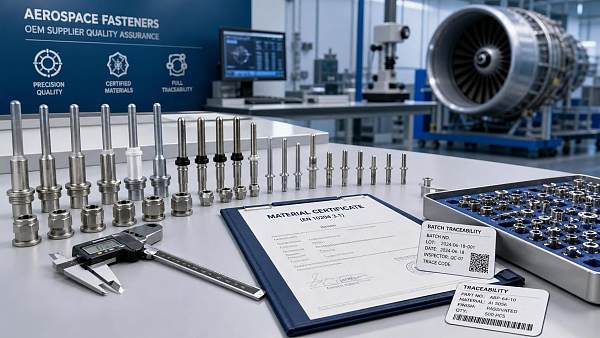
A credible source should show stable process capability, full batch traceability, and disciplined control over outsourced operations.
It should also demonstrate familiarity with aerospace standards, drawing interpretation, and material-specific manufacturing constraints.
Core evaluation points
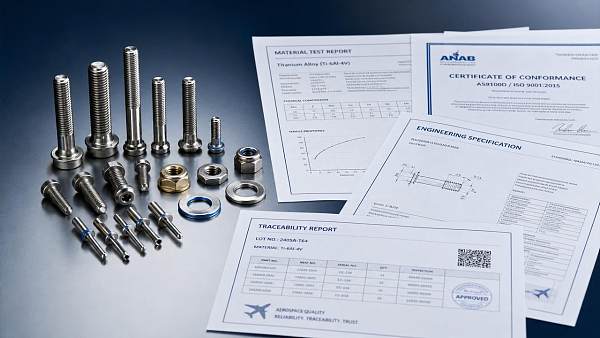
- Certification integrity: Verify material certificates, process records, and inspection documentation from source to shipment.
- Material expertise: Confirm capability with titanium, stainless steel, superalloys, and application-specific coatings.
- Tolerance consistency: Review statistical control, gauge calibration, and evidence of dimensional repeatability.
- Special process control: Examine heat treatment, plating, passivation, lubrication, and nondestructive testing oversight.
- Capacity resilience: Assess lead-time performance, safety stock logic, and contingency planning for constrained raw materials.
- Change management: Check how drawing revisions, substitutions, and nonconformities are documented and escalated.
This is where total cost becomes clearer. Superior Aerospace Fasteners sourcing reduces disruption, rework, and quality exposure over the full lifecycle.
How to build a smarter Aerospace Fasteners sourcing response
A stronger response begins with separating strategic Aerospace Fasteners from routine catalog items.
High-criticality parts deserve deeper qualification, longer planning horizons, and tighter approval controls.
Signals that a sourcing strategy is improving
- Fewer documentation holds at receiving inspection.
- Lower variation across lots and production sites.
- Better forecast alignment with supplier capacity.
- Reduced need for urgent substitutions.
- More stable lifecycle support for legacy and current platforms.
The next sourcing decision should be based on risk visibility, not price alone
Aerospace Fasteners sit at the intersection of safety, precision manufacturing, and supply-chain discipline.
That makes sourcing decisions highly consequential across quality performance, project timing, and long-term service reliability.
The strongest approach is to compare suppliers through verified traceability, process control, material competence, and delivery resilience.
For organizations managing complex industrial programs, Aerospace Fasteners should be treated as strategic risk items, not routine hardware lines.
A practical next step is to review current fastener categories, identify qualification gaps, and align future orders with documented criticality levels.
That shift creates better cost control, stronger compliance confidence, and a more dependable supply base for every mission-critical assembly.
Recommended News
 Oct 12, 2026How to Specify Low-VOC Fastener Coatings for Corrosion Protection and ComplianceLow VOC fastener coating specification guide: balance corrosion resistance, torque control, VOC compliance, and supplier validation for reliable assemblies.● Dr. Aris Alloy
 Oct 08, 2026Selecting Precision Fasteners for Semiconductor Equipment Vacuum and Cleanroom ServicePrecision Fasteners for semiconductor equipment: learn how to select vacuum- and cleanroom-ready hardware for reliable preload, low contamination, and long-term serviceability.● Dr. Aris Alloy
 Oct 04, 2026Selecting Stainless Micro Screws for Corrosion Resistance and Precision AssemblyStainless micro screws guide: choose corrosion-resistant alloys, precision threads, and reliable drive designs for demanding assemblies. Explore key selection tips.● Dr. Aris Alloy
 Oct 04, 2026How Do You Verify Precision Fastener Tolerances From a Datasheet?How do I verify precision fastener tolerances from a datasheet? Learn the key checks for thread class, dimensions, coatings, materials, and inspection methods.● Dr. Aris Alloy
 Sep 15, 2026Selecting Threaded Rods for Construction: Load, Corrosion, and Code RequirementsThreaded rods for construction: learn how to match load paths, corrosion protection, installation details, and code requirements for safer, compliant connections.● Dr. Aris Alloy
 Aug 16, 2026What Makes a High Strength Alloy Suitable for Aerospace Parts?High strength alloy for aerospace selection depends on more than tensile strength. Learn how fatigue, corrosion, heat, and manufacturability determine safer, lighter parts.● Dr. Aris Alloy
 Jul 26, 2026How Strong Are 3D Printed Fasteners in Load-Bearing Assemblies?3d printed fastener strength explained for load-bearing assemblies: learn where printed bolts work, where they fail, and how to choose safer, smarter fastening options.● Dr. Aris Alloy
 Jul 22, 2026How to Evaluate a Blind Bolt Custom OEM Partner for Aerospace Fastener ProjectsBlind bolt custom OEM sourcing for aerospace demands more than price. Learn how to assess quality systems, material traceability, engineering support, and supply stability before choosing a partner.● Dr. Aris Alloy
 Jul 18, 2026Salt Spray Hours for Fasteners: How to Compare Coatings and Corrosion ResistanceSalt spray hours fasteners explained: compare coatings, test limits, and real corrosion resistance to choose the right finish for longer service life and smarter sourcing.● Dr. Aris Alloy
 Jul 15, 2026Precision Fasteners Cost Factors: Materials, Tolerances, Finishes, and Order VolumePrecision Fasteners cost factors explained: compare materials, tolerances, finishes, and order volume to reduce sourcing risk, control total cost, and make smarter buying decisions.● Dr. Aris Alloy
 Jul 14, 2026How to Read a Titanium Alloy Weight Chart for Fastener and Aerospace Part SelectionTitanium alloy weight chart guide for fastener and aerospace part selection. Learn how to compare grade, density, dimensions, and standards to reduce sourcing risk.● Dr. Aris Alloy
 Jul 12, 2026How to Read Fastener Vibration Test Data for Joint Reliability DecisionsFastener vibration test data explained for smarter joint reliability decisions. Learn how to assess preload loss, residual clamp load, and test validity before sourcing or design approval.● Dr. Aris Alloy
 Jul 09, 2026Fastener Coating Cost Breakdown: What Changes Price by Material, Finish, and VolumeFastener coating cost explained: see how material, finish, volume, geometry, and compliance affect pricing, and learn how to compare quotes smarter while controlling total sourcing cost.● Dr. Aris Alloy
 Jul 06, 2026Self Tapping Industrial Screws: Types, Materials, and When to Use EachSelf tapping Industrial Screws guide: compare thread-forming, thread-cutting, and self-drilling types, materials, and best-use scenarios to choose faster, stronger, more reliable assemblies.● Dr. Aris Alloy
 Jul 05, 2026High-Tensile Bolts ASTM: How to Read Grades, Strength Classes, and Spec RequirementsHigh-Tensile Bolts ASTM guide: learn how to read grades, strength classes, specs, markings, and certificates to avoid sourcing mistakes and choose compliant bolts with confidence.● Dr. Aris Alloy
 Jul 04, 2026Stainless Automotive Fasteners Manufacturer: What Certifications and Materials Matter Most?Stainless automotive fasteners manufacturer selection starts with certifications, traceability, and the right alloys. Learn what matters most for reliable, compliant sourcing.● Dr. Aris Alloy
 Jul 03, 2026Fastener Price Trend 2026: What Steel Costs, Freight, and Demand Mean for BuyersFastener price trend 2026 explained: see how steel costs, freight volatility, and uneven demand may affect budgets, lead times, and sourcing decisions—so buyers can plan smarter.● Dr. Aris Alloy
 Jul 02, 2026Why Smart Fastener Battery Life Drops Early and How to Extend Service IntervalsSmart fastener battery life dropping too soon? Learn the real causes behind early drain and discover practical ways to extend service intervals without sacrificing monitoring accuracy.● Dr. Aris Alloy
 Jun 28, 2026Marine Grade Stainless Corrosion: What Causes It and How to Prevent Tea StainingMarine grade stainless corrosion often starts with tea staining. Learn the real causes, high-risk environments, and practical prevention steps to protect performance and cut lifecycle costs.● Dr. Aris Alloy
 Jun 26, 2026How to Choose Vibration-Resistant Fasteners for Aerospace AssembliesVibration-Resistant Fasteners for aerospace help protect critical assemblies from loosening, corrosion, and fatigue. Learn how to choose the right solution for safer, longer-lasting performance.● Dr. Aris Alloy
 Jun 23, 2026Fastener Hardness Explained: When to Use Rockwell vs Vickers TestingFastener hardness (Rockwell/Vickers) explained: learn when to use Rockwell for fast production checks and Vickers for precise surface analysis to improve quality, compliance, and reliability.● Dr. Aris Alloy
 Jun 15, 2026Wholesale Aerospace Fasteners: Specs, Materials, and Certifications Buyers Should CheckWholesale aerospace fasteners buyers should verify specs, material traceability, and certifications before ordering. Learn the key checks to reduce risk and source with confidence.● Dr. Aris Alloy
 Jun 07, 2026Instrument Cases Buying Guide: Hard vs Soft Cases, Protection Ratings, and FitInstrument cases buying guide: compare hard vs soft cases, understand IP protection ratings, and choose the right fit to protect sensitive equipment, reduce downtime, and buy with confidence.● Dr. Aris Alloy
 Jun 06, 2026How Global Construction Fastener Tenders Work: Bid Requirements, Specs, and Common RisksGlobal construction fastener tenders explained: learn bid requirements, key specs, compliance checks, and common risks to improve tender decisions and avoid costly project delays.● Dr. Aris Alloy