Hot Articles
Popular Tags
Best High-Pressure Hydraulic Cylinders for Construction
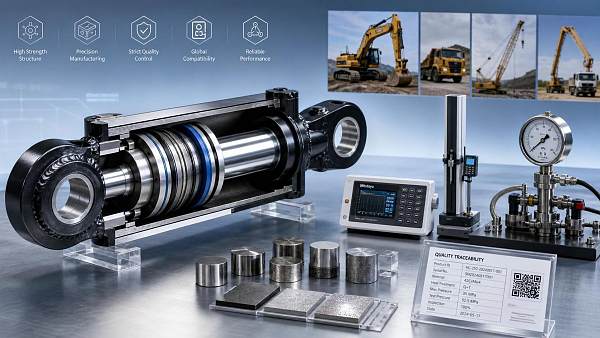
Selecting the best high-pressure hydraulic cylinders for construction is no longer just about choosing the highest rated component. For procurement teams, distributors, and commercial evaluators, the real question is which cylinder delivers reliable force output, long service life, manageable maintenance risk, and stable supply under demanding field conditions. In practice, the best option is the one that matches the machine duty cycle, pressure class, mounting requirements, environmental exposure, and after-sales support model—while reducing total downtime risk across the equipment lifecycle.
This guide is designed for readers who need more than generic product descriptions. It focuses on how to evaluate high-pressure hydraulic cylinders for construction from a technical, sourcing, and commercial perspective so that purchase decisions support operational uptime and long-term value.
What buyers really mean when they search for the best high-pressure hydraulic cylinders for construction
Most B2B readers searching this topic are not looking for a simple brand list. They usually want to answer one or more of these questions:
- Which cylinder types perform best in harsh construction environments?
- How do I compare specifications beyond bore size and stroke?
- What failure points create the most downtime in excavators, loaders, cranes, or lifting systems?
- Which suppliers are technically credible and commercially dependable?
- How can I reduce lifecycle cost, warranty issues, and replacement delays?
That is why the best evaluation approach combines engineering fit, seal and rod durability, pressure stability, manufacturing quality, compliance, and supply-chain reliability. A cylinder that looks cost-effective on paper may become expensive if it causes leakage, rod scoring, side-load failure, or delayed replacement in active projects.
Which high-pressure hydraulic cylinder types are most suitable for construction applications?
Construction equipment uses different cylinder designs depending on motion profile, load pattern, installation envelope, and contamination exposure. The best choice depends on the actual machine function rather than the broad equipment category alone.
Welded hydraulic cylinders
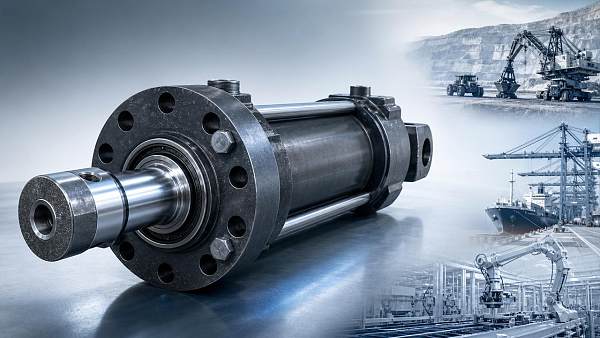
Welded cylinders are widely used in construction machinery because of their compact design, strong housing structure, and suitability for mobile equipment. They are common in excavators, backhoes, loaders, dump trucks, and attachments operating under high shock loads.
They are often preferred when:
- Space is limited
- High strength-to-size ratio is required
- Machines operate in rough, dirty, impact-heavy environments
- OEM integration and custom mounting configurations matter
Tie-rod hydraulic cylinders
Tie-rod cylinders are more common in industrial systems, but they may still appear in certain support or auxiliary construction applications where serviceability and standardization are priorities. They are generally easier to disassemble and maintain, but may be less ideal for severe mobile-duty conditions compared with heavy-duty welded designs.
Telescopic hydraulic cylinders
These are often selected for dump bodies, lifting functions, and applications requiring long stroke in a short retracted length. They offer packaging advantages but require careful quality control because multiple stages create more sealing and alignment complexity.
Double-acting vs. single-acting cylinders
Double-acting cylinders are usually the preferred choice in construction because they provide powered movement in both directions, improving control, repeatability, and operational safety. Single-acting cylinders may still be appropriate in simpler lifting or gravity-return systems.
What technical specifications matter most in real construction use?
Many buyers begin with bore, stroke, and operating pressure, but those alone do not identify the best cylinder for demanding construction work. The most important evaluation factors are the ones that directly affect uptime.
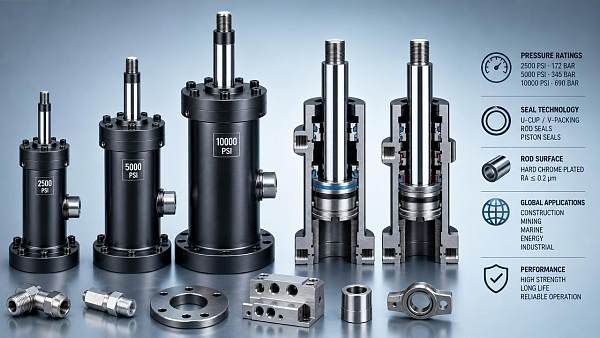
Pressure rating and pressure margin
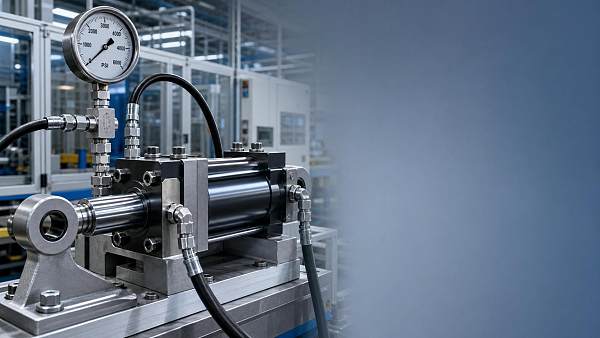
A high-pressure hydraulic cylinder should not only meet nominal working pressure but also maintain a safe and credible margin for peak loads, pressure spikes, and repetitive duty cycles. Construction equipment often sees fluctuating loads rather than smooth, steady-state operation.
Key questions include:
- What is the rated working pressure?
- What is the proof and burst pressure level?
- How does the design handle pressure spikes?
- Is the cylinder validated for dynamic duty or only static rating?
Rod material and surface treatment
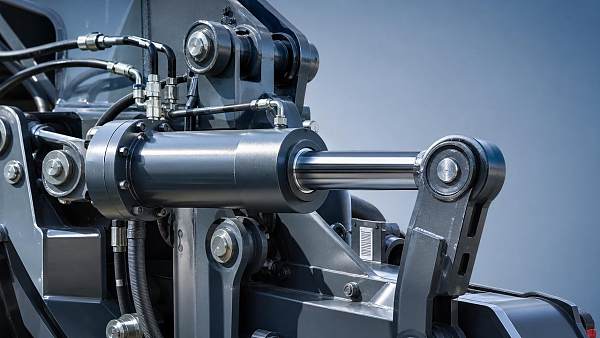
The piston rod is a major reliability factor. In construction environments, rods face abrasive particles, moisture, impacts, and potential corrosion. High-quality rod materials and surface treatments help prevent pitting, wear, seal damage, and premature leakage.
Look for:
- High-strength alloy steel rod stock
- Hard chrome plating or equivalent advanced surface treatment
- Strong corrosion resistance for outdoor and marine-adjacent use
- Tight straightness and finish tolerances
Seal system quality
Seal failure is one of the most common causes of hydraulic cylinder performance loss. The best high-pressure hydraulic cylinders for construction use seal systems designed for high contamination resistance, temperature variation, pressure cycling, and side-load conditions.
Assess:
- Seal material compatibility with hydraulic fluid and ambient conditions
- Wiper design for dirt exclusion
- Buffer seals for shock absorption
- Replacement seal kit availability
Bearing support and side-load resistance
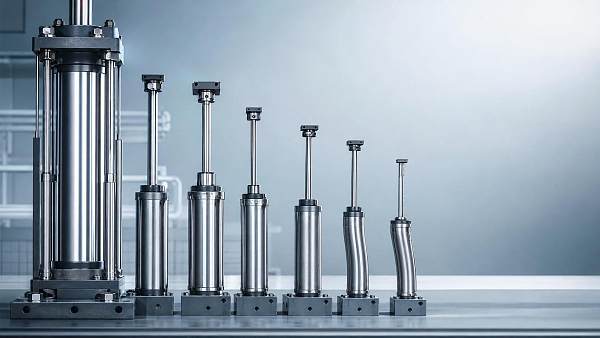
Not all failures come from pressure. Misalignment and side loading are frequent issues in booms, buckets, lifting arms, and articulated systems. A cylinder with insufficient bearing support can suffer rod wear, gland damage, and uneven seal degradation.
Tube, weld, and end-mount integrity
Construction duty places major stress on welded joints, mounting eyes, clevises, and trunnions. Manufacturing quality in these areas has a direct effect on fatigue life and safety. This is particularly important for fleet owners and distributors who must manage field reputation risk.
How to judge durability and total reliability instead of just initial price
For professional buyers, the best cylinder is usually not the cheapest unit. It is the one that minimizes the cost of failure. In construction, downtime can affect labor utilization, project schedules, equipment availability, and customer penalties.
A practical total reliability review should include:
- Expected service life under the intended duty cycle
- Historical leakage or rod failure rates
- Field repair complexity
- Availability of parts and service documentation
- Lead time for replacements
- Supplier consistency across batches
For example, a lower-cost cylinder may save money at purchase but create higher total cost if it needs frequent seal replacement, arrives with inconsistent tolerances, or lacks dependable technical support. Buyers responsible for uptime should calculate cost per operating hour, not just purchase price.
What industries and machine categories need the highest-performance cylinders?
Not every construction application needs the same performance level. Matching the cylinder to actual operating severity helps avoid both under-specification and unnecessary over-spending.
Excavators and heavy earthmoving equipment
These applications require strong pressure capability, high cycle durability, contamination resistance, and good side-load handling. Boom, arm, and bucket cylinders are especially critical because failure directly stops production.
Cranes and lifting systems
Here, safety, load stability, and smooth motion control are especially important. Buyers should pay close attention to sealing reliability, structural integrity, and compliance requirements.
Dump trucks and material transport equipment
Telescopic cylinders are common, and buyers should focus on stage sealing, stability under repeated extension cycles, and maintenance support.
Roadbuilding and compact equipment
Space constraints, repetitive use, and rough environments often favor compact welded designs with robust seals and efficient mounting layouts.
How procurement teams should compare suppliers and manufacturers
Supplier evaluation is as important as component evaluation. In a fragmented global supply environment, technical performance alone is not enough. Buyers need confidence in production control, documentation quality, and delivery reliability.
Use the following checklist when comparing hydraulic cylinder suppliers:
- Do they provide clear pressure, material, and tolerance specifications?
- Can they show testing procedures such as pressure testing, weld inspection, and seal validation?
- Do they support international standards and traceable quality systems?
- Can they deliver spare parts, seal kits, and repair support quickly?
- Are they experienced in construction-duty cylinders rather than only general industrial hydraulics?
- Do they offer custom engineering for mounting, stroke, porting, or environmental requirements?
- How resilient is their raw-material and export supply chain?
For sourcing teams that monitor multiple options, it may also be useful to benchmark supplier intelligence resources and category references such as 无 when reviewing broader market positioning and commercial readiness.
Common failure risks that buyers should try to prevent early
Many hydraulic cylinder problems can be reduced through better specification and supplier screening before purchase. The most common avoidable risks include:
- Incorrect pressure class for real operating peaks
- Poor rod coating quality leading to corrosion and seal wear
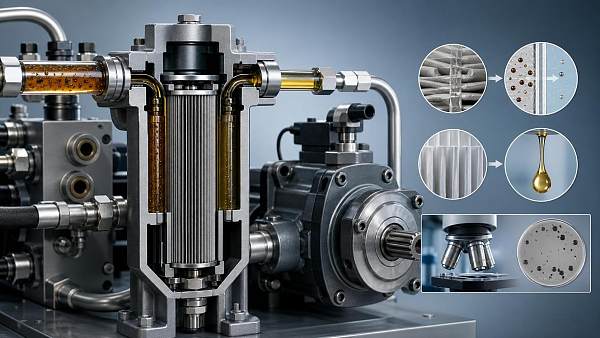
- Weak contamination control and inadequate wiper design
- Insufficient resistance to side loading or misalignment
- Low weld quality or poor mount machining accuracy
- Long spare-parts lead times after field failure
Procurement and engineering teams should jointly review field conditions such as dust, water exposure, shock loading, duty cycle intensity, and operator behavior. A technically correct specification can still fail if the real work environment was underestimated.
What distributors, dealers, and commercial evaluators should prioritize
For distributors and channel partners, the best high-pressure hydraulic cylinders for construction are not only those with strong engineering performance, but also those that are commercially sustainable to support.
Priority areas include:
- Stable product quality across repeat orders
- Reasonable stock planning and replenishment cycles
- Low warranty dispute rates
- Strong technical documents for downstream customers
- Compatibility with common machine platforms
- Responsive after-sales support
Commercial evaluators should also pay attention to whether the supplier can support regional market development, private labeling, technical training, and long-term account protection. A product that performs well but cannot be supported commercially may still create channel risk.
A practical framework for choosing the best option
If you need to make a shortlist quickly, use this five-point framework:
- Application fit: Match cylinder type, stroke, mounting, and pressure capacity to actual machine duty.
- Reliability design: Review rod treatment, seal system, side-load resistance, and structural integrity.
- Supplier capability: Confirm manufacturing controls, quality assurance, and engineering support.
- Service readiness: Check repair parts, lead times, documentation, and after-sales responsiveness.
- Total cost: Compare lifecycle value, not just unit price.
This method helps buyers avoid over-reliance on catalog numbers or headline pressure ratings alone.
Conclusion
The best high-pressure hydraulic cylinders for construction are the ones that combine technical strength, real-world durability, and dependable supply support. For procurement teams, distributors, and business evaluators, the smartest choice is rarely defined by maximum pressure alone. It is defined by how well the cylinder performs under actual construction duty, how reliably the supplier can support it, and how effectively the solution protects uptime and lifecycle cost.
If you are comparing options, focus first on application severity, seal and rod durability, side-load resistance, manufacturing quality, and service availability. That is the most practical way to identify a cylinder that supports total reliability instead of creating hidden operational risk.
Recommended News
 Sep 30, 2026How to Evaluate Electro-Hydraulic Servo Response for High-Speed Motion ControlEvaluate electro-hydraulic servo response for high-speed motion control with practical metrics for bandwidth, settling time, stability, and reliable supplier selection.● Marcus Valve
 Sep 22, 2026Selecting High-Pressure Hydraulic Cylinders for Press Force, Stroke, and Duty CycleHigh-Pressure Hydraulic Cylinders for presses: match force, stroke, mounting, and duty cycle for safer, more reliable performance and reduced downtime.● Marcus Valve
 Sep 03, 2026How ASTM Stainless Steel Standards Help Prevent Corrosion Failures in Hydraulic SystemsStainless corrosion ASTM standards help prevent hydraulic failures through verified material selection, passivation, traceability, and targeted corrosion testing. Learn how to specify reliable systems.● Marcus Valve
 Aug 20, 2026How to Calculate a Safe Cylinder Buckling Safety Factor Under Real Load ConditionsCylinder buckling safety factor explained: learn how to calculate a reliable margin under real load conditions, including stroke, end fixity, misalignment, and dynamic forces.● Marcus Valve
 Jul 14, 2026Hydraulic Market Forecast 2026: Demand Drivers, Price Pressure, and Supply Chain RisksHydraulic market forecast 2026 reveals key demand drivers, price pressure, and supply chain risks across industrial sectors. Discover actionable insights for smarter sourcing and planning.● Marcus Valve
 Jul 13, 2026How to Evaluate ISO-Certified Hydraulic Components for Supplier ApprovalHydraulic components ISO certified supplier approval requires more than checking certificates. Learn how to verify traceability, testing, and supplier reliability for safer sourcing.● Marcus Valve
 Jul 13, 2026Environmental Hydraulic Fluid Compliance Explained: Standards, Labels, and Approval StepsEnvironmental hydraulic fluid compliance explained in a practical guide covering ISO 15380, labels, OEM approvals, and approval steps to reduce risk, delays, and sourcing mistakes.● Marcus Valve
 Jul 10, 2026Hydraulic Components for Construction Equipment: Which Parts Matter Most in System Design?Hydraulic components for construction equipment determine efficiency, control, uptime, and lifecycle cost. Discover which parts matter most in system design and how to choose smarter.● Marcus Valve
 Jul 10, 2026How to Evaluate a Heavy Duty Hydraulic Cylinder Manufacturer for Construction ProjectsHeavy duty hydraulic cylinder manufacturer selection affects uptime, safety, and cost. Learn how to compare quality, testing, documentation, and delivery strength for construction projects.● Marcus Valve
 Jul 09, 2026Hydraulic Cylinder Pressure Ratings Explained: How to Read PSI, Burst, and Working LimitsHydraulic cylinder pressure ratings explained clearly: learn how to read PSI, working pressure, and burst limits to choose safer, longer-lasting cylinders and avoid costly system failures.● Marcus Valve
 Jul 08, 2026What Does Filter Beta Ratio Mean in Europe and How Is It Used in Hydraulic Filtration?Filter beta ratio Europe explained: learn how beta ratings measure hydraulic filtration efficiency, support ISO-based comparisons, and help buyers choose reliable filters with confidence.● Marcus Valve
 Jul 02, 2026Steel Cylinder Buckling Load Explained: Formula, End Conditions, and Design LimitsSteel cylinder buckling load explained clearly: learn the Euler formula, end conditions, and real design limits to compare options, reduce risk, and choose safer, more reliable cylinder solutions.● Marcus Valve
 Jul 01, 2026Fluid Power vs Electric Actuation: Key Differences in Force, Control, and MaintenanceFluid Power vs electric actuation: compare force, control, energy use, and maintenance to choose the right system for uptime, precision, and lower lifecycle risk.● Marcus Valve
![]() Jun 04, 2026Hydraulic Manifold Block Factory Guide: What to Review Before Requesting a QuoteHydraulic manifold block factory selection starts before the quote. Learn what to review on machining, pressure testing, cleanliness, traceability, and lead times to compare suppliers with confidence.● Marcus Valve
Jun 04, 2026Hydraulic Manifold Block Factory Guide: What to Review Before Requesting a QuoteHydraulic manifold block factory selection starts before the quote. Learn what to review on machining, pressure testing, cleanliness, traceability, and lead times to compare suppliers with confidence.● Marcus Valve May 30, 2026Why does hydraulic automation in construction news matter?Hydraulic automation in construction news reveals how smarter equipment boosts safety, productivity, energy efficiency, and reliability—see what trends matter now.● Marcus Valve
 May 28, 2026How Advanced Hydraulic systems cut downtime in heavy useAdvanced Hydraulic systems help cut downtime in heavy-use operations by improving pressure stability, reducing wear, and enabling faster fault detection for more reliable project delivery.● Marcus Valve
 May 27, 2026How Advanced Hydraulic systems cut downtime in heavy useAdvanced Hydraulic systems reduce downtime in heavy-use operations through better pressure stability, cleaner fluid control, and predictive maintenance for higher uptime and safer performance.● Marcus Valve
 May 26, 2026How Advanced Hydraulic systems cut downtime in high-load linesAdvanced Hydraulic systems cut downtime in high-load lines by improving pressure stability, durability, and maintenance planning. Discover smarter ways to boost uptime and control project risk.● Marcus Valve
 May 25, 2026How Advanced Hydraulic systems cut downtime in heavy useAdvanced Hydraulic systems cut downtime in heavy-use operations with stable pressure, durable components, and smarter maintenance insights. Learn how to improve uptime and lower lifecycle costs.● Marcus Valve
 May 24, 2026How Advanced Hydraulic systems cut downtime in heavy useAdvanced Hydraulic systems cut downtime in heavy-use operations by improving pressure stability, filtration, and component life. See how smarter hydraulic design boosts uptime and lowers service risk.● Marcus Valve
 May 23, 2026High-Pressure Hydraulic Cylinders selection mistakes to avoidHigh-Pressure Hydraulic Cylinders selection mistakes can cause downtime, leaks, and safety risks. Learn 10 buyer-focused pitfalls to avoid for smarter sourcing and longer service life.● Marcus Valve
 May 22, 2026How to compare high-pressure hydraulic cylindersHigh-Pressure Hydraulic Cylinders comparison guide: evaluate pressure ratings, seal reliability, fatigue life, compliance, and lifecycle cost to choose safer, longer-lasting solutions.● Marcus Valve
 May 21, 2026How to judge High-Pressure Hydraulic Cylinders for safetyHigh-Pressure Hydraulic Cylinders safety starts with more than rated pressure. Learn how to assess materials, seals, fatigue, testing, and compliance for safer, longer-lasting performance.● Marcus Valve
 May 21, 2026How Advanced Hydraulic designs cut downtime in harsh dutyAdvanced Hydraulic design helps cut downtime in harsh-duty industries through better sealing, fatigue resistance, corrosion protection, and predictive maintenance insights.● Marcus Valve