Hot Articles
Popular Tags
Fluid Power vs Electric Actuation in Harsh Duty Cycles
In harsh duty cycles, the choice between Fluid Power and electric actuation directly impacts uptime, safety, and lifecycle cost. For engineers and sourcing teams evaluating mission-critical systems, this comparison goes beyond efficiency claims to examine shock loads, contamination resistance, force density, maintenance risk, and long-term reliability in demanding industrial environments.
For information researchers in industrial procurement, the real question is not which technology is universally better. It is which actuation method matches the load profile, environmental exposure, maintenance capability, and failure tolerance of a specific operation.
Across steel processing, mining, marine handling, heavy automation, mobile equipment, and high-cycle manufacturing, Fluid Power remains a central benchmark because harsh service conditions often punish delicate assumptions. Dust, impact, washdown, temperature swings, and intermittent overloads can rapidly separate a laboratory winner from a field-proven solution.
Why harsh duty cycles change the actuation decision
A harsh duty cycle typically includes one or more of the following: peak load spikes above 125% of nominal force, repetitive cycling above 10,000 strokes per week, ambient temperatures outside 0°C to 40°C, airborne contamination, high vibration, or unplanned shock events.
In these environments, selection criteria shift. Engineers stop focusing only on energy efficiency and speed control. They prioritize force density, tolerance to abuse, failure behavior, serviceability, and spare-part resilience across a 5-year to 15-year operating window.
What makes Fluid Power competitive in severe service
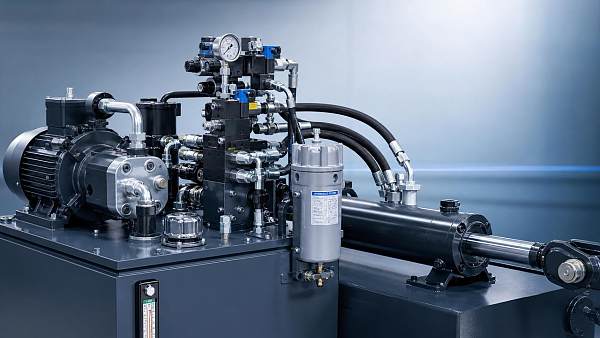
Fluid Power systems, especially hydraulic cylinders and hydraulic power units, deliver high force from compact envelopes. In applications needing 50 kN, 200 kN, or even above 1,000 kN, hydraulic architectures often achieve the target with less package growth than electric screw-based systems.
Another advantage is overload tolerance. Short-duration shock loading that might deform mechanical drive components can often be better managed through pressure relief settings, accumulator support, or controlled hydraulic damping. This matters in press lines, lifting equipment, clamping systems, and mobile platforms.
Key stressors that influence technology choice
- Contamination exposure: dust, slurry, chips, salt mist, coolant, or abrasive fines
- Dynamic load change: rapid acceleration, deceleration, and impact loading within 0.5 to 2 seconds
- Duty frequency: intermittent starts or continuous cycling over 16 to 24 hours per day
- Space constraints: need for high output force in limited machine footprints
- Safety requirements: fail-hold, controlled lowering, or safe-stop behavior during power loss
Electric actuation remains highly effective in cleaner, precision-oriented systems where force demand is moderate, feedback accuracy is critical, and maintenance teams are comfortable with servo tuning, encoder diagnostics, and gearbox condition checks.
The comparison below shows how decision-makers usually assess both technologies when uptime, abuse resistance, and total supportability are prioritized over headline efficiency numbers.
The practical takeaway is clear: if the application must survive overloads, contamination, and high force demand with predictable failure behavior, Fluid Power often stays ahead. If the process rewards motion precision more than brute resilience, electric actuation can be the better fit.
Performance differences in real industrial environments
Harsh duty cycles are rarely defined by one parameter alone. Most failures occur at the intersection of force, environment, and maintenance reality. A clean simulation may show equivalent output, but field conditions introduce side loads, uneven duty, operator misuse, and irregular lubrication intervals.
Shock loads and overload events
In forging support systems, waste compaction, shipboard equipment, and material handling rams, loads can jump 20% to 80% above normal in milliseconds. Hydraulic circuits can absorb or limit part of this event through pressure control and fluid compressibility effects.
Electric actuators, especially those using ball screws or planetary roller screws, can perform reliably, but repeated unmitigated impacts may accelerate wear at bearings, nuts, couplings, or gear stages. Protection requires careful derating, torque monitoring, and mechanical guarding.
Contamination, washdown, and ingress exposure
Mining, food handling, chemical processing, and outdoor automation expose actuators to water, mud, abrasive fines, and corrosive atmospheres. External sealing, surface treatment, and connector design become decisive. One weak cable gland or encoder seal can stop an electric axis unexpectedly.
Fluid Power is not immune. Hydraulic systems depend on fluid cleanliness, often managed within ISO cleanliness classes selected for the valve and pump design. However, rugged cylinders, hoses, and manifolds can continue serving in dirty environments where exposed electromechanical components require stricter protection.
Typical environment-to-technology fit
The matrix below is a useful screening tool during early specification reviews, especially when procurement teams need to narrow options before requesting detailed engineering validation.
This comparison does not remove the need for detailed engineering. It does, however, reduce early-stage mismatch risk by connecting application stressors to the dominant failure modes of each technology.
Lifecycle cost is more than energy consumption
Many sourcing discussions begin with power efficiency, but harsh duty economics are usually driven by downtime cost, service interval predictability, spare-part lead time, and recovery speed after a failure. A 2-hour stoppage in a critical line can outweigh months of theoretical energy savings.
Maintenance profiles differ in important ways
Fluid Power maintenance often includes fluid analysis every 3 to 6 months, seal inspection, hose replacement planning, filtration control, and leak tracking. These tasks are familiar in heavy industry and can be standardized across large equipment fleets.
Electric actuation reduces oil-related service, but it introduces other dependencies: encoder health, motor temperature behavior, firmware compatibility, cable integrity, and drivetrain wear. When failures occur, troubleshooting may require a more specialized skill set and replacement electronics availability.
Four cost drivers procurement teams should quantify
- Unplanned downtime cost per hour, including labor and lost output
- Mean time to repair, such as 2 hours versus 12 hours under real plant conditions
- Critical spare availability across 12 to 24 months of service planning
- Required technician skill depth for diagnosis, calibration, and restart
In some procurement workflows, researchers also review reference component listings such as 无 to benchmark naming conventions or supplier categorization, but the final selection should still be anchored in duty-cycle evidence rather than catalog labels alone.
Supply-chain resilience matters in actuator strategy
For global industrial buyers, component continuity is now part of system design. Hydraulic seals, hoses, valves, and cylinders are often easier to regionalize or cross-reference. Electric systems may depend on proprietary drives, firmware versions, or brand-specific feedback devices with 8 to 20 week replacement windows.
This is where a technical intelligence model like G-ISC adds value. Beyond comparing Fluid Power performance, decision-makers need visibility into standards alignment, cross-border sourcing risk, material volatility, and compatibility across the full actuation chain.
How engineers and sourcing teams should choose
A strong selection process usually moves through 5 steps: define the load case, map the environment, estimate service capability, screen supply risk, and validate failure behavior. This method prevents teams from overvaluing a single metric such as speed or nominal efficiency.
Step-by-step selection framework
1. Define real load, not brochure load
Record continuous load, peak load, side load, acceleration demand, and stall risk. If peak force exceeds nominal force by 30% or more, Fluid Power should remain under serious consideration.
2. Grade the environment
Use a simple 3-level rating for dust, water, chemicals, and vibration. A level-3 environment with persistent contamination or impact exposure often shifts value toward rugged hydraulic solutions.
3. Check maintenance reality
Ask whether the site has hydraulic technicians, servo specialists, spare filtration inventory, diagnostic software access, and shutdown windows. The right answer is the one your plant can actually support at 2 a.m., not just during commissioning.
4. Review standards and integration needs
Consider ISO, DIN, ASME, and machine-specific compliance requirements. Some projects prioritize motion networking and digital feedback. Others require simple, repairable, field-serviceable hardware with clear pressure and load margins.
5. Plan for failure mode containment
Evaluate what happens during power loss, hose rupture, encoder failure, overtemperature, or jam conditions. Controlled descent, load holding, and safe stop strategy should be defined before procurement, not after installation.
Common selection mistakes
- Assuming electric actuation always lowers total cost
- Ignoring shock events because average load looks acceptable
- Underestimating contamination and connector vulnerability
- Comparing only purchase price without downtime modeling
- Choosing proprietary architectures without spare-part strategy
A second reference checkpoint like 无 may help teams organize market research, yet the winning specification still depends on application evidence, repair logistics, and risk tolerance across the full lifecycle.
Best-fit scenarios for Fluid Power and electric actuation
Not every heavy-duty project requires a binary decision. In practice, many advanced systems use both technologies: Fluid Power for clamping, pressing, lifting, or damping, and electric actuation for indexing, positioning, or synchronized movement.
Still, if a single technology must carry the main working load under severe duty, Fluid Power usually excels where force density, impact tolerance, and ruggedness dominate. Electric actuation excels where cleanliness, precision, and digitally managed motion create measurable process value.
Where Fluid Power is often the stronger choice
- Heavy forming, clamping, and lifting above 50 kN
- Mobile or outdoor equipment with frequent shock loading
- Applications needing robust fail-hold or controlled lowering behavior
- Sites with established hydraulic maintenance capability
Where electric actuation often wins
- Clean automation cells with fine positioning requirements
- Repeatable medium-load processes with digital synchronization needs
- Facilities prioritizing reduced fluid handling and quieter operation
- Systems with strong controls engineering and electronics support
For harsh duty cycles, the most reliable buying decision is rarely driven by trend language. It comes from matching the actuator to real force, real contamination, real service constraints, and real downtime exposure. Fluid Power remains highly relevant because many industrial environments still reward resilience more than theoretical elegance.
If your team is comparing hydraulic and electric options for mission-critical equipment, use a structured review of load profiles, failure behavior, maintenance capability, and supply continuity before freezing specifications. To evaluate the right architecture for your application, contact us to get a tailored solution, discuss component details, or explore broader industrial sourcing options with greater technical confidence.
Recommended News
 Oct 14, 2026What is driving replacement demand in the piston pumps market?Piston pumps market replacement demand is rising as aging hydraulic systems face efficiency losses, automation needs, contamination risks, and costly downtime. Explore key drivers.● Marcus Valve
 Sep 24, 2026How to Read an NPSH Chart to Prevent Pump Cavitation in Process SystemsPump cavitation NPSH chart guide: learn to compare NPSHa and NPSHr across real operating conditions, prevent costly cavitation, and select safer process pump solutions.● Marcus Valve
 Sep 23, 2026Double Vane Pump Selection: Flow, Pressure, and Noise Factors for Hydraulic SystemsDouble vane pump selection made simple: compare flow, pressure, noise, inlet conditions, and duty cycles to improve hydraulic reliability and performance.● Marcus Valve
 Sep 10, 2026How to Calculate Hydraulic System Flow Rate for Cylinder Speed and Pump SizingHydraulic system flow rate calculation made practical: size pumps from cylinder speed, bore and rod area, efficiency, pressure, and real-world duty-cycle demands.● Marcus Valve
 Sep 07, 2026How to Evaluate Quiet Hydraulic Pump Suppliers for Low-Noise Industrial SystemsQuiet hydraulic pump suppliers: learn how to compare acoustic test data, pressure stability, production quality, and lifecycle support for reliable low-noise industrial systems.● Marcus Valve
 Aug 30, 2026Hydraulic Contamination Monitoring: Which Sensors Detect Wear Before Failure?Hydraulic contamination monitoring: discover which particle, ferrous debris, moisture, dielectric, and filter sensors detect wear early to prevent costly hydraulic failures.● Marcus Valve
 Jul 04, 2026Piston Pump Cavitation NPSH Explained: How to Diagnose Noise, Damage, and Flow LossPiston pump cavitation NPSH explained clearly: learn how to spot noise, pitting, and flow loss early, diagnose root causes fast, and prevent costly hydraulic downtime.● Marcus Valve
 Jun 29, 2026Hydraulic Pump Noise Standards Explained: Test Methods, dB Limits, and Compliance BasicsHydraulic pump noise standards explained in clear terms—learn test methods, dB limits, and compliance basics to compare pumps accurately, reduce risk, and make smarter sourcing decisions.● Marcus Valve
 Jun 21, 2026How to Evaluate a Piston Pump Manufacturer for Pressure Rating, Materials, and Lead TimePiston pump manufacturer selection starts with proven pressure ratings, material compatibility, and reliable lead times. Learn how to compare suppliers with less risk and better long-term value.● Marcus Valve
 Jun 18, 2026Gear Pump Wholesale Pricing Explained: What Affects MOQ, Materials, and Lead Time?Gear pump wholesale pricing explained: learn how MOQ, materials, machining precision, testing, and lead time affect total cost, supplier risk, and smarter sourcing decisions.● Marcus Valve
 May 28, 2026What Fluid Power data matters most when comparing pumps?Fluid Power pump comparison goes beyond pressure and flow. Learn which data truly matters—efficiency, contamination tolerance, heat, noise, and reliability—to cut downtime and lifecycle cost.● Marcus Valve
 May 23, 2026What should you verify before choosing a Fluid Power system?Fluid Power system selection starts with verification. Learn what to check for load, pressure, fluid compatibility, temperature, and support to avoid downtime and choose with confidence.● Marcus Valve
 May 22, 2026What fluid power issues cause the most downtime?Fluid Power downtime often starts with contamination, pressure loss, overheating, and seal failure. Learn the top causes, compare risks, and improve system reliability faster.● Marcus Valve
 May 21, 2026What makes Fluid Power a better fit than electric drive?Fluid Power often outperforms electric drive in high-force, shock-heavy, and safety-critical applications. Discover why it delivers better uptime, durability, and load control.● Marcus Valve
 May 20, 2026How Fluid Power compares with electric drive on costFluid Power cost vs electric drive: compare upfront investment, energy use, maintenance, and TCO to choose the most cost-effective motion solution for your operation.● Marcus Valve
 May 19, 2026What fluid power mistakes drive up downtime most?Fluid Power downtime often starts with small mistakes. Learn how contamination, pressure settings, component selection, and maintenance planning drive costly stops—and how to prevent them.● Marcus Valve
 May 18, 2026How fluid power choices affect uptime and repair costsFluid Power choices directly impact uptime and repair costs. Discover a practical checklist to reduce failures, improve reliability, and lower lifecycle maintenance expenses.● Marcus Valve
 May 17, 2026What Fluid Power Mistakes Still Drive Up Energy Use?Fluid Power mistakes still inflate energy use through oversizing, throttling, leakage, and poor maintenance. Discover practical fixes to cut costs, boost reliability, and improve hydraulic efficiency.● Marcus Valve
 May 16, 2026What Fluid Power buyers should compare before quotingFluid Power buyers should compare pressure ratings, seal compatibility, material traceability, lead times, and supplier support before quoting to reduce risk, control lifecycle cost, and improve uptime.● Marcus Valve
 May 14, 2026Fluid Power vs Electric Actuation in Harsh Duty CyclesFluid Power vs electric actuation in harsh duty cycles: compare shock resistance, force density, contamination tolerance, and lifecycle cost to choose the most reliable solution.● Marcus Valve
 May 13, 2026Fluid Power vs electric actuators in heavy-duty linesFluid Power vs electric actuators: discover which solution delivers better force, uptime, precision, and lifecycle value in heavy-duty lines before you decide.● Marcus Valve
 May 07, 2026Fluid Power vs Electric Actuation in Heavy EquipmentFluid Power vs electric actuation in heavy equipment: compare force density, precision, maintenance, and lifecycle cost to choose the smartest, most reliable solution.● Marcus Valve
 May 03, 2026What makes advanced hydraulic technology pay off faster?Advanced Hydraulic technology drives faster Operational Uptime improvement through Total Reliability standards, smarter sourcing, and predictive supply chain case studies in manufacturing.● Marcus Valve
![]() May 01, 2026Critical Components That Quietly Raise Downtime RiskCritical Components for industrial applications drive hidden downtime risk. Learn how Total Reliability certification and Supply-Chain Orchestration for manufacturing improve uptime.● Marcus Valve
May 01, 2026Critical Components That Quietly Raise Downtime RiskCritical Components for industrial applications drive hidden downtime risk. Learn how Total Reliability certification and Supply-Chain Orchestration for manufacturing improve uptime.● Marcus Valve