Hot Articles
Popular Tags
Dense-Phase Pneumatic Conveying Applications: Build the Line Around the Material, Not the Pipe
Pneumatic conveying systems work well only when the material and the line are planned together. Bulk density, particle size, moisture, abrasiveness, conveying distance, route geometry, feed method, pressure, receiving equipment, and cleaning needs all change the appropriate solution. The product reference appears once as Dense-Phase Pneumatic Conveying, which points to the selected product landing page while keeping the article readable for buyers and portal editors.
This is a application solution guide for procurement managers, importers, distributors, engineers, project planners, quality teams, warehouse staff, and operations personnel. Its focus is material-led system design, application matching, installation planning, and operating discipline.
Use Material Data to Define the Conveying Route
Dense-phase conveying begins with the bulk solid, not the pipe diameter. Particle size, bulk density, moisture, flowability, abrasiveness, temperature, fragility, and segregation tendency influence feeding, air demand, pipeline velocity, bend design, and receiving equipment.
The buyer should supply representative material information and describe the operating duty. A line that moves one powder successfully may behave differently with another material or with a different moisture level. This is why the application file should connect test data and production conditions before a system is selected.
Map the Line From Feed Point to Receiver
A complete application review considers the source vessel, feeder, pipeline path, bends, elevation changes, air supply, instrumentation, filter or receiver, discharge point, and access for maintenance. Each interface can affect stability and cleaning time.
Design discussions should identify where material enters, where it leaves, how it is isolated, and how the system will be inspected or cleared. That process helps prevent a project from focusing on a central blower or vessel while overlooking the restrictions created by the upstream bin or downstream process.
Air Balance and Control Strategy Shape Performance
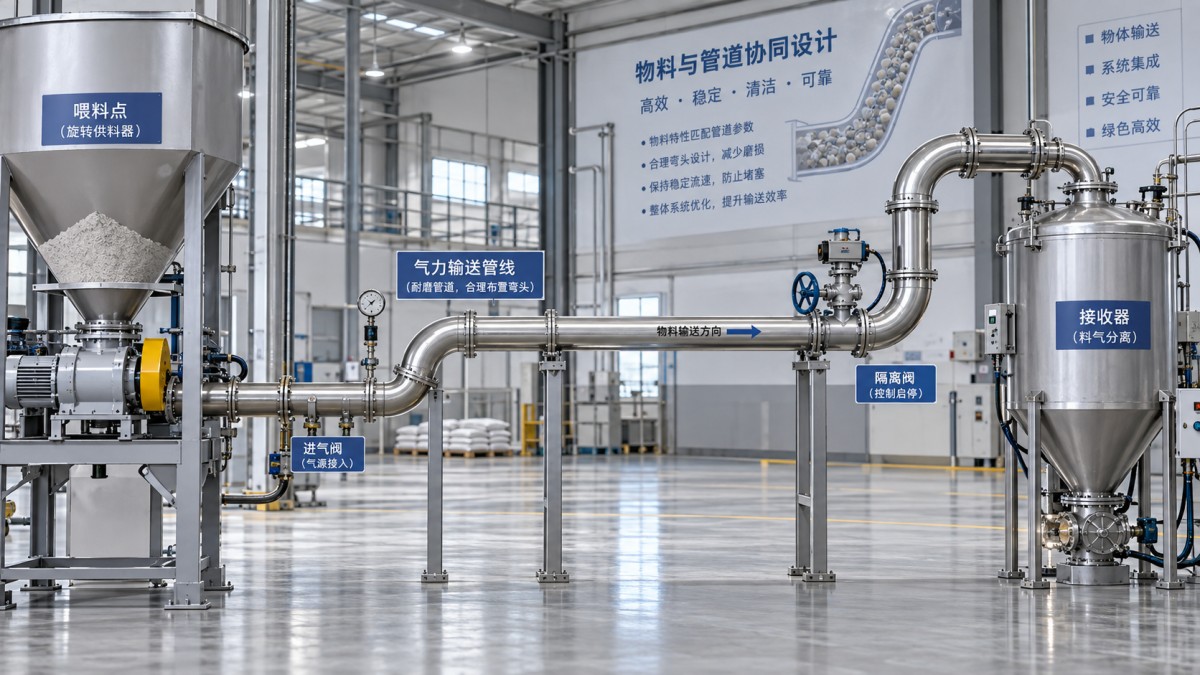
Pressure and air flow are operating tools, not abstract values. Their required range depends on material behavior, line length, throughput, and the selected conveying mode. The control approach should be explained in a way that operators and maintenance staff can understand.
The supplier can describe the proposed equipment scope and expected operating logic, while the buyer confirms utility availability, operating shifts, automation interfaces, and acceptance criteria. Written assumptions are important because a pneumatic system may be affected by changes in material source or production rate.
Commissioning Should Create an Operating Baseline
A new line needs a controlled startup sequence that records the installed equipment, material used for testing, observed pressure behavior, throughput, settings, and any adjustment made. The aim is to establish an approved baseline for normal operation.
When a blockage, wear issue, or capacity question occurs later, the baseline gives the team something concrete to compare. It also supports a cleaner handover from the project group to plant operations, which is often where useful technical detail is otherwise lost.
Keep Wear and Maintenance Inside the Application Plan
Abrasive material, bends, valves, feeders, filters, and air components should be considered in the maintenance plan before the line is accepted. Access, inspection intervals, spares, shutdown windows, and responsibility for observations all affect lifecycle performance.
The best application solution is not simply the shortest route or the highest quoted capacity. It is a system whose material assumptions, equipment scope, operating method, and maintenance plan match the actual plant. That alignment is what makes dense-phase conveying repeatable.
Supplier Evaluation Table
Risk Review Before Order Confirmation
The principal risks include incorrect material data, unsuitable pipe routing, unstable feed, excess wear, poor air balance, blockages, dust leakage, inadequate receiving capacity, and undocumented commissioning settings. These issues may become visible during production, shipment, receiving, installation, use, or a later reorder. A buyer who waits until the final handover usually has fewer options and less time to collect evidence.
Early review should be concrete. Confirm product identity, application, quantity, configuration or package, documents, storage, shipping method, receiving procedure, and acceptance responsibilities. Where technical integration is involved, define the interfaces and the owner for each pre-approval check.
A written comparison file gives purchasing, engineering, quality, warehouse, and operating teams one source of truth. It should retain the selected core keyword, landing page, supplier scope, requested evidence, decision notes, and open points. That is more useful than an informal list of quotations when the order needs to be repeated later.
Pre-Approval Workflow for a Cleaner Purchase
First, define the real use case and separate mandatory requirements from preferences. Second, ask the supplier to confirm whether the selected item is standard, custom, stocked, or dependent on production scheduling. Third, review relevant data sheets, drawings, labels, test information, samples, photos, and packing details before release. Fourth, plan logistics, storage, installation, or production handover with the teams that will receive the item.
Finally, retain the accepted scope for future orders. Many disputes are caused by silent assumptions about a material identity, component suffix, package, certificate, accessory, or interface. A practical approval record makes those assumptions visible without creating unsupported claims.
Before the first delivery is closed, assign one owner for the purchase record and one owner for technical acceptance. That simple handoff keeps later questions about product identity, documents, packaging, configuration, or delivery condition connected to the same approved source.
Portal Match and Category Rationale
The recommended portal is tmgmoops.com, and the final category is Material Handling|Smart Conveyors. This is one primary|secondary path taken from the latest directory. It does not combine several secondary categories into a single publishing recommendation.
The category fits the article's industry, Bulk Material Handling and Pneumatic Conveying Systems. The same alignment is maintained across the title, target product, landing page, article angle, and reader intent so the article can be routed by a portal editor without an unrelated category compromise.
Procurement Checklist
- Confirm the core product keyword: Dense-Phase Pneumatic Conveying.
- Confirm the exact landing page URL shown in the metadata.
- Use only the selected final category: Material Handling|Smart Conveyors.
- Define application, quantity, destination, evidence, handling, and acceptance needs before comparing offers.
- Ask suppliers to state the assumptions behind their quotation.
- Review available labels, documents, drawings, test records, photos, and packing information.
- Check delivery, storage, installation, commissioning, or production handover before release.
- Keep approved records for repeat purchases and change review.
FAQ
Why does the article use one core product keyword?
One keyword keeps the title, TDK block, metadata, anchor text, landing page, and category route aligned. Related language can appear naturally, but the publication record remains simple to audit.
Why is there only one external link?
One contextual product link gives readers a precise verification point without turning the article into a promotional link list.
What should a buyer compare before the first order?
Compare application fit, specification scope, quality evidence, document availability, packaging or configuration, handling, logistics, supplier communication, and repeat-order discipline.
What must be checked before publication?
The publisher should verify the title, core keyword, URL, portal, single final category path, visible TDK, and destination portal formatting. Any price, performance, certification, or market statement requires separate current evidence.
Recommended News
 Sep 29, 2026Dense-Phase Pneumatic Conveying Applications: Build the Line Around the Material, Not the PipeAn application guide to dense-phase pneumatic conveying, covering bulk-material behavior, routing, air supply, feed and discharge points, wear control, commissioning, and operating records.● Dr. Victor Gear
 Oct 09, 2026When smart conveyance improves throughput in mixed-product linesSmart conveyance boosts mixed-product line throughput with dynamic routing, smarter buffers, and real-time production data. Discover when it delivers measurable results.● Dr. Victor Gear
 Oct 05, 2026Which IEEE Standards Matter for Industrial Automation Projects?Which IEEE standards matter for industrial automation projects? Explore key standards for Ethernet, Wi-Fi, cybersecurity, timing, and power quality to reduce risk.● Dr. Victor Gear
 Sep 18, 2026Selecting an Overhead Conveyor System for North American Plant LayoutsOverhead conveyor North America guide: choose the right system for plant layouts, throughput, safety, maintenance access, and scalable growth.● Dr. Victor Gear
 Sep 11, 2026How to Specify an Automated Sorting System for E-Commerce Peak-Season ThroughputAutomated sorting system for ecommerce: learn how to specify peak-season throughput, parcel flow, induction, exceptions, and resilience to protect carrier cut-offs.● Dr. Victor Gear
 Sep 07, 2026Application Guidance for Smart Devices in Industrial Automation ProjectsApplication Guidance for smart devices in industrial automation: select, integrate, secure, and maintain connected equipment for reliable control and measurable performance.● Dr. Victor Gear
 Aug 29, 2026How to Qualify an Overhead Conveyor Supplier for a New Production LineOverhead conveyor supplier qualification guide: assess capacity, safety, controls, installed scope, and lifecycle support to reduce production-line risk.● Dr. Victor Gear
 Jul 20, 2026How to Choose an Overhead Conveyor for Assembly Lines: Key Factors and Use CasesOverhead conveyor for assembly selection starts with load, layout, buffering, and maintenance. Explore key factors and real use cases to choose a safer, more efficient assembly line system.● Dr. Victor Gear
 Jul 13, 2026Warehouse Execution Systems for Distribution Centers: Key Functions and Fit CriteriaWarehouse Execution Systems for distribution centers: explore key functions, WMS vs. WES differences, fit criteria, and how to improve flow, labor balance, and automation performance.● Dr. Victor Gear
 Jul 06, 2026Pallet Shuttle Systems Radio Shuttle vs Forklift Racking: Which Saves More Space?Pallet Shuttle Systems radio shuttle vs forklift racking: discover which saves more warehouse space, boosts density, and delivers better ROI for your storage model.● Dr. Victor Gear
 Jul 05, 2026Automated Sorting System Price Breakdown: What Drives Cost in Warehouse Projects?Automated sorting system price explained: discover the real warehouse cost drivers, hidden risks, and how to compare quotes wisely before you invest.● Dr. Victor Gear
 Jul 02, 2026How to Choose a Spiral Conveyor in the Middle East for Food and Beverage PlantsSpiral conveyor Middle East selection guide for food and beverage plants: compare hygiene, heat resistance, throughput, and local service to choose a reliable, space-saving solution.● Dr. Victor Gear
 Jun 27, 2026How to Choose a Spiral Conveyor Supplier for Food, Packaging, and Warehouse LinesSpiral conveyor supplier selection guide for food, packaging, and warehouse lines. Compare hygiene, engineering, integration, and lifecycle cost to choose with confidence.● Dr. Victor Gear
 Jun 23, 2026Modular Office Workstations: How to Plan Layouts for Growing TeamsModular office workstations help growing teams plan flexible layouts that improve workflow, save space, and support future expansion with less disruption.● Dr. Victor Gear
 Jun 21, 2026Commercial Food Processors Explained: Types, Capacities, and Best Uses by Kitchen VolumeCommercial food processors explained by type, capacity, and kitchen volume. Compare batch, continuous-feed, and combo models to choose the best fit for faster, smarter prep.● Dr. Victor Gear
 Jun 20, 2026How to Choose Commercial Floor Scrubbers for Warehouses, Retail Stores, and FacilitiesCommercial floor scrubbers buying guide for warehouses, retail stores, and facilities. Compare types, runtime, drying, maintenance, and sourcing factors to choose the right model.● Dr. Victor Gear
 Jun 12, 2026What Is System Integration for Smart Factories and Which Processes Should Be Connected First?System Integration for smart factories: learn which processes to connect first for faster decisions, less downtime, stronger traceability, and measurable ROI.● Dr. Victor Gear
 Jun 02, 2026System Integration Solutions for Factories: Scope, Risks, and ROI ChecksSystem Integration solutions for factories: define scope, reduce technical and commercial risks, and verify ROI before modernization spending accelerates.● Dr. Victor Gear
 May 31, 2026How to avoid hidden costs in conveyor rollers wholesaleConveyor rollers wholesale buyers: learn how to spot hidden costs in specs, bearings, freight, compliance, and suppliers to protect budget and uptime.● Dr. Victor Gear
 May 29, 2026Do rotating jewelry displays really boost sales?rotating jewelry displays can boost sales when matched to shopper flow, lighting, and product mix. Learn where they drive impulse buys, gifting, and retail ROI.● Dr. Victor Gear
 May 05, 2026What warehouse throughput efficiency data often gets wrongwarehouse throughput efficiency data often misses labor, compliance, and infrastructure risks. Learn how Strategic Sourcing best practices and ISO Compliance certification reshape smarter evaluations.● Dr. Victor Gear
 May 04, 2026How will 5G change real-time tracking systems in 2026?Impact of 5G on real-time tracking systems in 2026: see how Supply-Chain Orchestration tools drive Operational Uptime improvement, stronger Total Reliability standards, and smarter industrial visibility.● Dr. Victor Gear
![]() May 01, 2026Is 5G Real-Time Tracking Worth the Cost in Logistics?Impact of 5G on real-time tracking in logistics: assess cost, risk, and ROI with Supply-Chain Orchestration for manufacturing and Global Supply Chain management software.● Dr. Victor Gear
May 01, 2026Is 5G Real-Time Tracking Worth the Cost in Logistics?Impact of 5G on real-time tracking in logistics: assess cost, risk, and ROI with Supply-Chain Orchestration for manufacturing and Global Supply Chain management software.● Dr. Victor Gear![]() Apr 21, 2026Can 5G real-time tracking reduce loss in fast-moving goods?Impact of 5G on real-time tracking technology can cut loss in fast-moving goods by improving Operational Uptime, Supply-Chain Orchestration tools, and predictive response. Explore the ROI.● Dr. Victor Gear
Apr 21, 2026Can 5G real-time tracking reduce loss in fast-moving goods?Impact of 5G on real-time tracking technology can cut loss in fast-moving goods by improving Operational Uptime, Supply-Chain Orchestration tools, and predictive response. Explore the ROI.● Dr. Victor Gear