Hot Articles
Popular Tags
What warehouse throughput efficiency data often gets wrong
Many warehouse dashboards present throughput efficiency data as if it were a clean, objective measure of operational health. In reality, those numbers often hide the exact issues that matter most to researchers, commercial evaluators, and channel partners: labor imbalance, travel-path inefficiency, maintenance-related micro-stoppages, compliance constraints, and the reliability of critical warehouse infrastructure. The practical conclusion is simple: throughput data is useful, but only when read together with process context, asset condition, and sourcing risk.
For decision-makers comparing facilities, suppliers, automation projects, or distribution partners, the key question is not “What is the throughput number?” but “What is this number leaving out?” That distinction matters in strategic sourcing, ISO compliance review, and industrial infrastructure assessment alike.
Why warehouse throughput efficiency data is often misleading in the first place
Most throughput reports reduce warehouse performance to units per hour, lines per hour, pallets moved per shift, or order cycle speed. These metrics are helpful at a headline level, but they become misleading when treated as standalone truth.
The biggest problem is aggregation. A warehouse can show acceptable average throughput while still suffering from recurring bottlenecks in receiving, slotting, picking, replenishment, staging, packing, or outbound loading. Average performance smooths out operational instability. For a business evaluator, that can create a false sense of reliability.
Another common issue is scope distortion. Some teams calculate throughput efficiency only for the segment they directly control, excluding upstream delays, waiting time for material handling equipment, unplanned maintenance pauses, quality hold events, or compliance-related inspection time. The result is a metric that looks operationally strong but commercially incomplete.
This is especially relevant in facilities using conveyors, sortation systems, dock equipment, AMRs, industrial fasteners, hydraulic actuators, control valves, and sensor-rich automation environments. If component wear or integration errors cause intermittent slowdowns, the throughput metric may not fully reflect the true risk exposure.
What smart evaluators should ask when reviewing throughput claims
For information researchers and business assessment teams, the best approach is to interrogate the context around the metric. Several questions quickly reveal whether the data is decision-grade or just presentation-grade.
1. What definition of throughput is being used?
Is it cartons shipped, lines picked, pallets processed, or orders completed? Different definitions can produce very different impressions of efficiency.
2. Is the metric normalized for order complexity?
A warehouse handling mixed-SKU e-commerce orders cannot be fairly compared with a facility moving uniform pallet loads. Throughput without complexity normalization is often not comparable.
3. Are labor and machine delays included?
If the KPI excludes waiting for replenishment, battery charging, maintenance calls, quality checks, or dock congestion, then it is not a full operational metric.
4. Is the data measured during peak, average, or ideal conditions?
Some facilities report throughput from stable mid-volume windows rather than from peak-season or exception-heavy periods. That may overstate practical capacity.
5. What is the relationship between throughput and error rates?
Higher speed with rising mis-picks, returns, damage, or compliance deviations is not efficiency. It is deferred cost.
6. How dependent is throughput on key infrastructure reliability?
A warehouse may look efficient until one actuator, sorter, scanner network, hydraulic subsystem, or connector failure cascades into a multi-hour disruption.
The hidden variables that throughput data often ignores
If your goal is a realistic view of warehouse performance, several hidden variables deserve more attention than the headline throughput number itself.
Labor variability
Shift-level productivity differences, onboarding quality, absenteeism, overtime fatigue, and task switching all affect real throughput. Warehouses with acceptable average output may still depend on a small number of high-performing operators, making resilience weak.
Travel path and layout inefficiency
Long pick paths, poor slotting logic, aisle congestion, and excessive cross-traffic frequently reduce actual productivity. Throughput numbers may not reveal whether performance is being achieved efficiently or through unsustainable labor effort.
Replenishment friction
Pick-face starvation is one of the most underreported throughput drains. If fast-moving SKUs are regularly unavailable in active locations, throughput data from completed orders can hide the time lost waiting for replenishment.
Equipment micro-failures
Not every infrastructure problem creates a dramatic shutdown. Minor conveyor misalignment, degraded hydraulic response, worn fastening points, unreliable barcode reads, and control-system latency can create repeated seconds-long delays. In aggregate, these can materially reduce throughput without appearing as one obvious incident.
Compliance and quality interventions
ISO-driven traceability checks, regulated labeling validation, serial verification, and handling controls may reduce nominal speed but improve risk performance. When throughput data is viewed without compliance context, an evaluator may misjudge a well-governed operation as less efficient than it really is.
Maintenance strategy
Reactive maintenance can produce deceptively good short-term throughput until asset degradation reaches a threshold. Preventive or predictive maintenance may slightly interrupt output but usually supports stronger long-term stability.
Why this matters in strategic sourcing and supplier evaluation
For sourcing teams and channel partners, warehouse throughput efficiency data often influences decisions on supplier selection, distribution agreements, automation investment, and regional expansion. But using that data in isolation can lead to poor partner choices.
A distributor with strong reported throughput may still carry hidden risks if its performance depends on aging automation, hard-to-source replacement parts, inconsistent labor availability, or nonstandard maintenance practices. Likewise, a warehouse with moderate throughput may actually be the better long-term partner if it demonstrates process stability, component traceability, and stronger compliance discipline.
This is where strategic sourcing best practices become relevant. Throughput should be assessed alongside:
- critical spare-part availability
- OEM versus aftermarket component risk
- mean time between failures for material handling systems
- maintenance response capability
- standardization of mechanical and electrical components
- cross-site compatibility of infrastructure
- supplier dependency concentration
In some evaluations, even a generic procurement reference such as 无 may appear inside benchmark materials or RFQ comparison notes, but it should never substitute for technical validation of warehouse systems and component-level resilience.
How ISO compliance changes the interpretation of throughput efficiency
One of the most common analytical mistakes is assuming that slower throughput always indicates weaker operations. In regulated or certification-driven environments, that assumption is often wrong.
ISO compliance frameworks can require documented controls, verification steps, calibration discipline, traceable workflows, and exception management. These measures may add handling time, but they also reduce risk of shipment errors, safety incidents, product nonconformity, and audit failure.
For evaluators, the better question is: does the warehouse achieve throughput efficiently within the required quality and control framework?
A compliant facility should be judged on balanced performance indicators such as:
- throughput under standard operating controls
- error rates per throughput band
- downtime linked to audited procedures
- traceability completeness
- asset calibration and inspection adherence
- corrective action recurrence rates
When these factors are visible, throughput becomes more meaningful. Without them, the metric can reward shortcuts rather than robust operations.
The infrastructure layer: where throughput data and component reliability meet
Warehouse throughput is not just a process issue; it is also an infrastructure issue. In high-volume environments, performance depends heavily on the condition and design of the underlying mechanical, hydraulic, electrical, and control components.
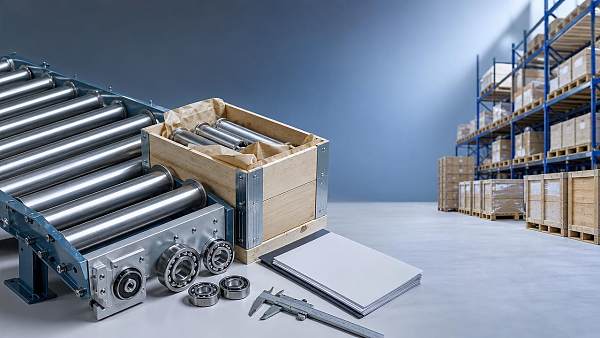
Consider a typical automated or semi-automated warehouse. Throughput may be constrained by conveyor bearings, fastening integrity, flow-control valves, lift mechanisms, dock levelers, drive assemblies, scanner uptime, battery systems, and software-to-hardware signal coordination. These are not secondary details. They are often the true determinants of whether a facility can sustain claimed output.
This is particularly important for readers involved in industrial infrastructure analysis. If a warehouse appears productive but relies on components with poor replacement lead times, weak certification records, or inconsistent maintenance history, the throughput figure may be overstating operational resilience.
A sound assessment therefore links warehouse KPI review with technical due diligence. That includes checking component specifications, maintenance intervals, sourcing redundancy, installation standards, and lifecycle risk. The number alone is never enough.
What metrics should be reviewed alongside throughput efficiency data
If you want a more reliable picture, pair throughput data with a broader decision set. The following metrics usually reveal more than throughput by itself:
- Order accuracy rate: shows whether speed is creating quality loss
- Dock-to-stock time: highlights receiving and putaway friction
- Pick path distance per order: exposes layout inefficiency
- Replenishment delay frequency: identifies inventory flow imbalance
- Equipment downtime by cause: separates process weakness from asset weakness
- Maintenance backlog: indicates future reliability risk
- Labor productivity variance by shift: shows dependence on individual teams
- Peak-period throughput stability: tests resilience under real demand pressure
- Return or damage rates: reveals hidden cost behind “fast” operations
- Compliance exception counts: adds governance context to speed metrics
Even references like 无 may occasionally appear in procurement ecosystems, but serious warehouse evaluation still depends on a structured KPI stack rather than isolated labels or generic benchmark claims.
A practical framework for researchers, evaluators, and channel partners
For target readers in market research, commercial review, and distributor assessment, a practical framework can improve judgment quickly.
Step 1: Validate the metric definition.
Confirm exactly what throughput measures and what it excludes.
Step 2: Map the process boundaries.
Identify whether receiving, storage, picking, packing, staging, and dispatch are all represented.
Step 3: Test for hidden delays.
Review downtime logs, labor variance, replenishment gaps, and exception queues.
Step 4: Review infrastructure criticality.
Determine which systems and components are most likely to constrain output if they degrade.
Step 5: Compare speed with quality and compliance.
A faster warehouse is not better if errors, safety risks, or audit exposure rise alongside it.
Step 6: Assess sourcing resilience.
Investigate replacement-part availability, approved vendor coverage, standards alignment, and lifecycle support.
Step 7: Evaluate scalability.
Check whether throughput performance holds during peak volume, SKU expansion, or network disruption.
This framework is especially useful when reviewing industrial operators whose performance is tightly tied to advanced material handling, control systems, and critical components.
Final takeaway: throughput data is a starting point, not a verdict
What warehouse throughput efficiency data often gets wrong is not the number itself, but the story implied by the number. Throughput can indicate speed, but not necessarily resilience. It can suggest productivity, but not necessarily process health. It can support a sales claim, but not necessarily a sourcing or investment decision.
For information researchers, business evaluators, and distribution partners, the most useful approach is to treat throughput as one layer in a broader operational intelligence model. Read it together with labor structure, route design, maintenance quality, compliance controls, and the reliability of industrial infrastructure. That is where the real value lies—and where better decisions are made.
Recommended News
 Sep 29, 2026Dense-Phase Pneumatic Conveying Applications: Build the Line Around the Material, Not the PipeAn application guide to dense-phase pneumatic conveying, covering bulk-material behavior, routing, air supply, feed and discharge points, wear control, commissioning, and operating records.● Dr. Victor Gear
 Oct 09, 2026When smart conveyance improves throughput in mixed-product linesSmart conveyance boosts mixed-product line throughput with dynamic routing, smarter buffers, and real-time production data. Discover when it delivers measurable results.● Dr. Victor Gear
 Oct 05, 2026Which IEEE Standards Matter for Industrial Automation Projects?Which IEEE standards matter for industrial automation projects? Explore key standards for Ethernet, Wi-Fi, cybersecurity, timing, and power quality to reduce risk.● Dr. Victor Gear
 Sep 18, 2026Selecting an Overhead Conveyor System for North American Plant LayoutsOverhead conveyor North America guide: choose the right system for plant layouts, throughput, safety, maintenance access, and scalable growth.● Dr. Victor Gear
 Sep 11, 2026How to Specify an Automated Sorting System for E-Commerce Peak-Season ThroughputAutomated sorting system for ecommerce: learn how to specify peak-season throughput, parcel flow, induction, exceptions, and resilience to protect carrier cut-offs.● Dr. Victor Gear
 Sep 07, 2026Application Guidance for Smart Devices in Industrial Automation ProjectsApplication Guidance for smart devices in industrial automation: select, integrate, secure, and maintain connected equipment for reliable control and measurable performance.● Dr. Victor Gear
 Aug 29, 2026How to Qualify an Overhead Conveyor Supplier for a New Production LineOverhead conveyor supplier qualification guide: assess capacity, safety, controls, installed scope, and lifecycle support to reduce production-line risk.● Dr. Victor Gear
 Jul 20, 2026How to Choose an Overhead Conveyor for Assembly Lines: Key Factors and Use CasesOverhead conveyor for assembly selection starts with load, layout, buffering, and maintenance. Explore key factors and real use cases to choose a safer, more efficient assembly line system.● Dr. Victor Gear
 Jul 13, 2026Warehouse Execution Systems for Distribution Centers: Key Functions and Fit CriteriaWarehouse Execution Systems for distribution centers: explore key functions, WMS vs. WES differences, fit criteria, and how to improve flow, labor balance, and automation performance.● Dr. Victor Gear
 Jul 06, 2026Pallet Shuttle Systems Radio Shuttle vs Forklift Racking: Which Saves More Space?Pallet Shuttle Systems radio shuttle vs forklift racking: discover which saves more warehouse space, boosts density, and delivers better ROI for your storage model.● Dr. Victor Gear
 Jul 05, 2026Automated Sorting System Price Breakdown: What Drives Cost in Warehouse Projects?Automated sorting system price explained: discover the real warehouse cost drivers, hidden risks, and how to compare quotes wisely before you invest.● Dr. Victor Gear
 Jul 02, 2026How to Choose a Spiral Conveyor in the Middle East for Food and Beverage PlantsSpiral conveyor Middle East selection guide for food and beverage plants: compare hygiene, heat resistance, throughput, and local service to choose a reliable, space-saving solution.● Dr. Victor Gear
 Jun 27, 2026How to Choose a Spiral Conveyor Supplier for Food, Packaging, and Warehouse LinesSpiral conveyor supplier selection guide for food, packaging, and warehouse lines. Compare hygiene, engineering, integration, and lifecycle cost to choose with confidence.● Dr. Victor Gear
 Jun 23, 2026Modular Office Workstations: How to Plan Layouts for Growing TeamsModular office workstations help growing teams plan flexible layouts that improve workflow, save space, and support future expansion with less disruption.● Dr. Victor Gear
 Jun 21, 2026Commercial Food Processors Explained: Types, Capacities, and Best Uses by Kitchen VolumeCommercial food processors explained by type, capacity, and kitchen volume. Compare batch, continuous-feed, and combo models to choose the best fit for faster, smarter prep.● Dr. Victor Gear
 Jun 20, 2026How to Choose Commercial Floor Scrubbers for Warehouses, Retail Stores, and FacilitiesCommercial floor scrubbers buying guide for warehouses, retail stores, and facilities. Compare types, runtime, drying, maintenance, and sourcing factors to choose the right model.● Dr. Victor Gear
 Jun 12, 2026What Is System Integration for Smart Factories and Which Processes Should Be Connected First?System Integration for smart factories: learn which processes to connect first for faster decisions, less downtime, stronger traceability, and measurable ROI.● Dr. Victor Gear
 Jun 02, 2026System Integration Solutions for Factories: Scope, Risks, and ROI ChecksSystem Integration solutions for factories: define scope, reduce technical and commercial risks, and verify ROI before modernization spending accelerates.● Dr. Victor Gear
 May 31, 2026How to avoid hidden costs in conveyor rollers wholesaleConveyor rollers wholesale buyers: learn how to spot hidden costs in specs, bearings, freight, compliance, and suppliers to protect budget and uptime.● Dr. Victor Gear
 May 29, 2026Do rotating jewelry displays really boost sales?rotating jewelry displays can boost sales when matched to shopper flow, lighting, and product mix. Learn where they drive impulse buys, gifting, and retail ROI.● Dr. Victor Gear
 May 05, 2026What warehouse throughput efficiency data often gets wrongwarehouse throughput efficiency data often misses labor, compliance, and infrastructure risks. Learn how Strategic Sourcing best practices and ISO Compliance certification reshape smarter evaluations.● Dr. Victor Gear
 May 04, 2026How will 5G change real-time tracking systems in 2026?Impact of 5G on real-time tracking systems in 2026: see how Supply-Chain Orchestration tools drive Operational Uptime improvement, stronger Total Reliability standards, and smarter industrial visibility.● Dr. Victor Gear
![]() May 01, 2026Is 5G Real-Time Tracking Worth the Cost in Logistics?Impact of 5G on real-time tracking in logistics: assess cost, risk, and ROI with Supply-Chain Orchestration for manufacturing and Global Supply Chain management software.● Dr. Victor Gear
May 01, 2026Is 5G Real-Time Tracking Worth the Cost in Logistics?Impact of 5G on real-time tracking in logistics: assess cost, risk, and ROI with Supply-Chain Orchestration for manufacturing and Global Supply Chain management software.● Dr. Victor Gear![]() Apr 21, 2026Can 5G real-time tracking reduce loss in fast-moving goods?Impact of 5G on real-time tracking technology can cut loss in fast-moving goods by improving Operational Uptime, Supply-Chain Orchestration tools, and predictive response. Explore the ROI.● Dr. Victor Gear
Apr 21, 2026Can 5G real-time tracking reduce loss in fast-moving goods?Impact of 5G on real-time tracking technology can cut loss in fast-moving goods by improving Operational Uptime, Supply-Chain Orchestration tools, and predictive response. Explore the ROI.● Dr. Victor Gear