Hot Articles
Popular Tags
Why Precision Fasteners Loosen in High-Vibration Assemblies
Why do Precision Fasteners still loosen in high-vibration assemblies despite tight tolerances and high preload? For technical evaluators, the answer lies in the interaction of dynamic loads, joint design, surface conditions, material behavior, and locking methods. This article outlines the root causes of self-loosening and highlights the engineering factors that determine whether a fastening system maintains clamp force, reliability, and safety under continuous vibration.
Why a checklist-based review is the fastest way to assess vibration loosening risk
For technical evaluation teams, loosening in high-vibration joints is rarely caused by a single mistake. It is usually the result of several acceptable-looking conditions combining into one unstable assembly: insufficient clamp load margin, joint slip, poor embedding resistance, low transverse stiffness, or a locking method that does not match the excitation profile. That is why Precision Fasteners should not be reviewed only by tensile strength, torque value, or catalog grade.
A checklist-based approach helps evaluators prioritize what actually matters in service: whether the joint can retain preload, resist relative movement, and survive cyclic loading without progressive loss of clamp force. It also prevents a common procurement error—assuming that a premium fastener alone can compensate for weak joint geometry, rough interfaces, or uncontrolled installation variables.
First-pass checklist: the key factors to confirm before blaming the fastener
Before concluding that the hardware is defective, technical evaluators should review the full fastening system. In most high-vibration applications, Precision Fasteners fail to hold preload because the joint system allows microscopic slip under repeated transverse load.
- Confirm whether the dominant vibration is axial, transverse, rotational, impact-based, or mixed. Self-loosening is especially likely under transverse cyclic movement.
- Check whether the specified preload is high enough relative to the external dynamic load, not just high enough to meet static strength criteria.
- Review joint stiffness balance. A very stiff bolt with a compliant clamped stack can lose effective clamp force more quickly during settlement and vibration.
- Inspect bearing surfaces, coatings, washers, and mating materials for embedding, creep, or friction inconsistency.
- Verify installation method: torque control alone may create large preload scatter if friction is unstable.
- Assess whether the selected locking feature is intended for repeated vibration, not just light-duty anti-rotation.
- Check assembly access and tooling alignment. Off-axis tightening can distort preload and seating behavior.
- Review service temperature, corrosion exposure, lubrication state, and maintenance intervals because these conditions alter friction and clamp retention.
Core mechanism: why Precision Fasteners loosen under vibration
The best-known mechanism is self-loosening induced by relative movement between clamped parts. Under cyclic transverse loading, the joint can experience micro-slip at the interface. Once friction is intermittently overcome, the preload that keeps the thread flank and bearing surfaces locked begins to decline. The nut or bolt does not need to rotate much at first; preload can drop significantly before visible back-off appears.
This is why Precision Fasteners in aerospace, rail, rotating machinery, hydraulic modules, automated handling frames, and mobile equipment are evaluated as a system rather than as isolated threaded parts. Even a high-tensile, close-tolerance bolt may loosen if the joint stack settles, if coatings crush under load, or if external shear is carried by friction alone when a locating feature should have been used.
Engineering checklist: the seven most important causes of clamp loss
1. Insufficient preload relative to dynamic excitation
A joint can pass a static torque check and still fail in vibration service. If preload is too low, interface slip begins earlier, and once sliding starts the resistance to rotation decreases sharply. Evaluators should compare estimated service load spectra with usable preload after installation scatter, relaxation, and seating loss—not with nominal torque values alone.
2. Transverse joint movement
Side-to-side motion is one of the most critical triggers for self-loosening. This often occurs when the joint is asked to transmit shear through clamp friction alone. If operating loads are high, dowels, sleeves, fitted shanks, serrated interfaces, or dedicated locating features may be required to reduce dependence on friction at the bolted interface.
3. Embedding and settlement at contact surfaces
Flattening of rough peaks, coating compression, gasket creep, and localized yielding all reduce bolt elongation and therefore preload. Settlement losses are especially important in painted structures, plated surfaces, mixed-metal joints, and soft stack materials. In many cases, the fastener is performing correctly while the interface is relaxing.
4. Friction variability during tightening
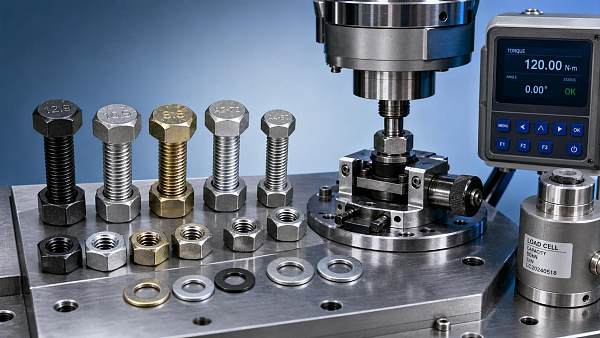
Torque is only an indirect indicator of preload. If thread friction and under-head friction vary because of lubrication inconsistency, coating changes, contamination, or reused parts, the same torque can produce very different clamp loads. For critical Precision Fasteners, angle control, tension control, or direct preload verification may be more reliable than basic torque-only methods.
5. Mismatch between locking method and vibration severity
Not all locking devices perform equally under severe cyclic loads. Some methods mainly increase prevailing torque during assembly but do little to preserve clamp force after interface slip begins. Evaluators should distinguish between anti-rotation features, preload retention strategies, and true wedge-locking mechanisms.
6. Joint stiffness and grip-length problems
Very short grip lengths can make a bolted joint more sensitive to settlement and dynamic load fluctuation because the bolt has less elastic stretch to absorb change. A longer effective grip, where feasible, often improves clamp retention by increasing fastener elasticity relative to the clamped members.
7. Material and environment effects
Thermal cycling, corrosion products, galvanic interaction, hydrogen-related concerns, and differential expansion can all reduce long-term reliability. In outdoor, marine, power generation, and process environments, material grade selection should be reviewed together with surface treatment and maintenance planning.
Quick decision table for technical evaluators
Use the following matrix to identify where to investigate first when Precision Fasteners show preload loss or recurrent service loosening.
Application-specific checks: what changes by assembly type
Rotating equipment and motors
Focus on frequency match, imbalance-driven vibration, and whether the joint sees continuous transverse excitation. Shaft-adjacent housings and motor frames often need better surface control and more consistent preload verification than general structural joints.
Hydraulic and fluid power systems
Pressure pulsation adds cyclic load even when external vibration appears moderate. Evaluate sealing compression, manifold flatness, and whether thermal and pressure cycles are reducing clamp force over time. In this context, Precision Fasteners are part of a leak-prevention system, not only a structural connector.
Automated material handling and mobile platforms
Impact events, start-stop cycles, and frame flexure are often more important than nominal rated load. Review whether the joint is positioned near wheel modules, gearboxes, guide rails, or moving actuators where repeated shock can accelerate loosening.
Aerospace, rail, and safety-critical transport
Traceability, validated locking systems, fatigue resistance, and inspection intervals are mandatory review points. Here, a seemingly minor washer or coating substitution can change friction behavior enough to invalidate the original tightening specification.
Commonly overlooked risks that distort the evaluation
- Assuming higher torque always means higher safety. Over-tightening can damage threads, crush interfaces, or increase scatter if lubrication is uncontrolled.
- Ignoring the effect of coatings and finishes. Zinc flake, phosphate, dry film lubricant, and other finishes can significantly alter friction and embedding behavior.
- Reusing prevailing-torque nuts or damaged washers in critical joints.
- Treating all vibration-resistant products as equivalent without test evidence under representative transverse loading.
- Neglecting the clamped parts. Soft substrates, painted interfaces, slotted holes, or poor flatness frequently drive the failure mode.
- Skipping residual preload checks after first run, thermal stabilization, or early service cycles.
Execution guide: how to evaluate and improve a loosening-prone assembly
- Define the real load case. Gather vibration direction, amplitude, frequency, shock events, temperature range, and duty cycle.
- Map the joint stack. Document materials, thicknesses, coatings, hole types, washers, and contact surface conditions.
- Validate installation control. Record torque tool capability, lubrication state, tightening sequence, and achieved preload method.
- Measure or estimate settlement. Include paint compression, gasket behavior, and interface flattening after initial service.
- Review whether shear transfer relies too much on friction alone. Add mechanical location features where needed.
- Compare locking options based on test data, serviceability, temperature compatibility, and maintenance constraints.
- Run representative validation, ideally using transverse vibration testing or application-specific endurance testing rather than simple bench torque checks.
For sourcing and engineering teams that benchmark suppliers across industrial categories, even a placeholder item such as 无 should be assessed through the same discipline: preload consistency, interface compatibility, traceability, and validated vibration performance matter more than nominal grade alone.
What technical data should be requested from suppliers
When selecting Precision Fasteners for vibration-sensitive assemblies, evaluators should request more than dimensional drawings and material certificates. The most useful supplier inputs include tightening coefficient range, recommended installation conditions, reuse limitations, coating specification, prevailing torque characteristics if applicable, vibration test references, proof load data, hardness range, and compatibility notes for washers or mating nuts. If the assembly is safety-critical, ask for lot traceability, inspection protocol, and relevant standard conformance such as ISO, DIN, or ASME references.
FAQ for technical evaluators
Are tighter tolerances enough to stop loosening?
No. Tighter tolerances can improve fit and consistency, but they do not eliminate transverse slip, settlement, or preload loss caused by poor joint design and uncontrolled friction.
Is threadlocker always the best answer?
Not always. Threadlocker can help, but performance depends on gap, temperature, contamination, disassembly requirements, and vibration severity. It should be matched to the application rather than used as a universal fix.
Should evaluation focus more on bolt grade or on joint design?
Joint design usually has the larger impact on loosening resistance. Bolt grade matters, but preload retention is strongly influenced by interface behavior, grip length, stiffness ratio, and installation control.
Final checklist for next-step decisions
If a company needs to improve reliability in high-vibration assemblies, the priority is to collect the right evidence before changing part numbers. Confirm the service load profile, current clamp-load method, surface and coating condition, joint settlement risk, locking strategy, and validation standard. For procurement and engineering alignment, the most useful next discussion points are target preload window, acceptable installation scatter, environmental exposure, maintenance interval, test method, lead time, and total lifecycle cost. In other words, successful use of Precision Fasteners depends on evaluating the full system path from design intent to field behavior.
Recommended News
 Oct 07, 2026Selecting High-Tensile Bolts for Structural Steel Connections Under Dynamic LoadsHigh tensile bolt construction for dynamic steel joints: learn how preload, slip resistance, fatigue design, and installation control improve safety.● Dr. Aris Alloy
 Sep 05, 2026Nylon Insert Lock Nut Price: How to Compare Total Cost, Quality, and Supply TermsNylon insert lock nut price explained: compare total landed cost, quality, materials, traceability, lead times, and supply terms for smarter sourcing.● Dr. Aris Alloy
 Sep 04, 2026How Smart Fastener Manufacturing Integrates Sensors for Real-Time Joint MonitoringSmart fastener manufacturing integrates sensors for real-time joint monitoring, helping engineers improve safety, maintenance planning, compliance, and lifecycle reliability.● Dr. Aris Alloy
 Jun 29, 2026How to Choose Stainless Nylon Lock Nuts for Vibration and Corrosion-Prone AssembliesStainless nylon lock nuts: learn how to choose the right grade, torque retention, and temperature fit for vibration- and corrosion-prone assemblies to reduce failure risk.● Dr. Aris Alloy
 Jun 27, 2026Metric Nylon Lock Nuts: Sizes, Materials, and When to Use Them in Vibration-Prone AssembliesMetric nylon lock nuts explained: compare sizes, materials, temperature limits, and ideal use cases for vibration-prone assemblies to choose safer, longer-lasting fastening solutions.● Dr. Aris Alloy
 Jun 25, 2026High-Tensile Bolts Specifications Explained: Grade, Size, Coating, and Load RatingsHigh-Tensile Bolts specifications explained clearly—compare grade, size, coating, and load ratings to avoid failures, improve compliance, and choose the right bolt with confidence.● Dr. Aris Alloy
 Jun 17, 2026How to Read Vibration-Resistant Fasteners Specifications for High-Vibration EquipmentVibration-Resistant Fasteners specifications explained: learn how to assess strength, locking methods, standards, coatings, and installation data to choose safer, longer-lasting fastening solutions.● Dr. Aris Alloy
 Jun 08, 2026Vibration Proof Nuts Wholesale: Key Grades, Thread Types, and Supplier ChecksVibration proof nuts wholesale guide: compare key grades, thread types, locking methods, and supplier checks to cut loosening risk, reduce downtime, and source with confidence.● Dr. Aris Alloy
 May 28, 2026Why Precision Fasteners fail under vibration more oftenPrecision Fasteners often fail under vibration due to preload loss, joint design flaws, and installation error. Learn the real causes and how to improve reliability.● Dr. Aris Alloy
 May 24, 2026Why Precision Fasteners fail under vibration more oftenPrecision Fasteners fail under vibration when preload drops, slip begins, and fatigue accelerates. Learn the hidden causes and practical fixes to improve joint reliability.● Dr. Aris Alloy
 May 23, 2026Why Precision Fasteners fail early in high vibration assembliesPrecision Fasteners fail early in high-vibration assemblies due to preload loss, joint slip, and fatigue. Learn the warning signs and selection tips to improve reliability.● Dr. Aris Alloy
 May 19, 2026How precision fasteners affect quality and rework costsPrecision Fasteners improve assembly accuracy, reduce rework costs, and boost product reliability. Learn how better fastening control cuts defects, downtime, and hidden production losses.● Dr. Aris Alloy
 May 17, 2026How Precision Fasteners Affect Fatigue Life in Real AssembliesPrecision Fasteners play a critical role in fatigue life. Learn how preload stability, thermal cycling, and fit accuracy improve durability and reduce assembly failure risk.● Dr. Aris Alloy
 May 16, 2026Precision Fasteners fail early for these common reasonsPrecision Fasteners fail early due to material mismatch, poor installation, dynamic loads, and corrosion. Discover the key warning signs and practical fixes to improve reliability.● Dr. Aris Alloy
 May 15, 2026Precision Fasteners Fail Early for Reasons Many Specs MissPrecision Fasteners fail early when specs ignore vibration, corrosion, preload loss, and thermal cycling. Learn the hidden causes and smarter fixes to improve uptime.● Dr. Aris Alloy
 May 09, 2026Precision Fasteners Fail Early for Reasons Most Specs MissPrecision Fasteners fail early when specs ignore preload loss, vibration, friction, and thermal cycling. Discover the hidden risks and smarter ways to improve joint reliability.● Dr. Aris Alloy
 May 07, 2026Why Precision Fasteners Loosen in High-Vibration AssembliesPrecision Fasteners can still loosen in high-vibration assemblies. Discover the key causes of clamp loss and practical checks to improve joint reliability, safety, and performance.● Dr. Aris Alloy
 May 04, 2026Which Vibration-Resistant Fasteners specs prevent field failures?Vibration-Resistant Fasteners specifications that prevent field failures: compare preload retention, locking validation, fatigue strength, and Total Reliability standards to drive Operational Uptime improvement.● Dr. Aris Alloy
 May 02, 2026Do Vibration-Resistant Fasteners Really Cut Aerospace Risk?Vibration-Resistant Fasteners for aerospace: learn how they reduce joint failure risk, improve Operational Uptime, and support smarter strategic sourcing decisions.● Dr. Aris Alloy
![]() Apr 29, 2026How to compare vibration-resistant fasteners suppliers?How to compare a Vibration-Resistant Fasteners supplier: evaluate Total Reliability certification, Industrial Procurement strategy, and supply-chain orchestration for lower risk.● Dr. Aris Alloy
Apr 29, 2026How to compare vibration-resistant fasteners suppliers?How to compare a Vibration-Resistant Fasteners supplier: evaluate Total Reliability certification, Industrial Procurement strategy, and supply-chain orchestration for lower risk.● Dr. Aris Alloy Apr 28, 2026Why vibration-resistant fasteners fail despite the specWhy vibration-resistant fasteners fail despite the spec: learn how a Vibration-Resistant Fasteners supplier should prove preload retention, fatigue resistance, and real joint reliability.● Dr. Aris Alloy
![]() Apr 27, 2026Vibration-Resistant Fasteners Specs That Matter MostVibration-Resistant Fasteners specifications that matter most: preload retention, locking methods, fatigue, coatings, and test standards—learn how to reduce failures and improve uptime.● Dr. Aris Alloy
Apr 27, 2026Vibration-Resistant Fasteners Specs That Matter MostVibration-Resistant Fasteners specifications that matter most: preload retention, locking methods, fatigue, coatings, and test standards—learn how to reduce failures and improve uptime.● Dr. Aris Alloy Apr 21, 2026High-Tensile Bolts Fail Early for Reasons Torque Charts MissHigh-Tensile Bolts fail early when torque charts miss preload loss, vibration, and joint design risks. Learn how Industrial Manufacturing teams improve reliability, sourcing, and standards compliance.● Dr. Aris Alloy