Hot Articles
Popular Tags
How precision fasteners affect fit, cost, and rework
Precision Fasteners play a decisive role in assembly accuracy, lifecycle cost, and the amount of rework a production line must absorb. In complex industrial systems, the fastener is not a minor commodity.
It is a dimensional control point, a load path, and a reliability trigger. When Precision Fasteners are specified well, parts align correctly, torque values hold, and downstream variation stays contained.
When they are chosen poorly, fit problems spread quickly. Holes misalign, mating surfaces distort, vibration loosens joints, and rework costs rise across machining, assembly, inspection, and field service.
Across general industry, this matters even more now. Tighter tolerances, multi-site production, and fragmented sourcing have made Precision Fasteners a practical lever for quality stability and supply-chain resilience.
Precision Fasteners and their role in fit control
Precision Fasteners are engineered fastening components with tightly controlled dimensions, material properties, thread geometry, surface finish, and mechanical performance. They are designed to reduce variation in critical joints.
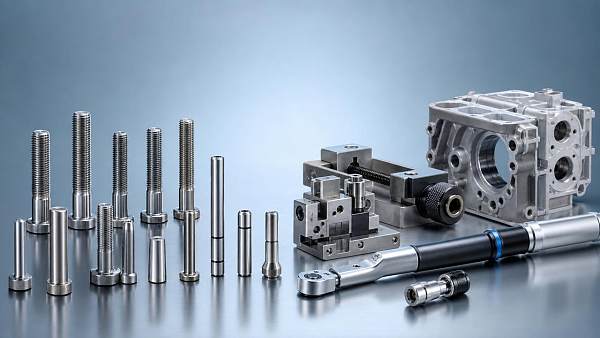
Common examples include high-tolerance bolts, shoulder screws, precision pins, captive fasteners, aerospace-grade screws, and vibration-resistant threaded components built to ISO, DIN, or ASME requirements.
Fit is affected by more than nominal diameter. Thread pitch accuracy, concentricity, straightness, head geometry, under-head bearing surface, and coating thickness all influence final assembly behavior.
In high-value assemblies, a small deviation can create stack-up error. That error may force operators to enlarge holes, add shims, retorque joints, or reject matched components entirely.
Precision Fasteners help control these risks because they narrow the spread between design intent and installed condition. Better consistency means less adjustment at the line and fewer quality escapes later.
Core attributes that influence fit
- Dimensional tolerance on shank, head, and thread features
- Material hardness and tensile strength consistency
- Coating uniformity affecting torque and hole clearance
- Surface finish and burr control
- Traceability to lot, process, and compliance records
Why industry is paying closer attention
Industrial operations are under pressure to improve uptime, reduce scrap, and standardize quality across global plants. These conditions have moved Precision Fasteners from a catalog item to a risk-management decision.
Several shifts explain the renewed focus. Assemblies are lighter yet stronger. Product platforms share parts across regions. Compliance expectations are stricter. And hidden rework costs are now measured more closely.
This is especially relevant in hydraulic systems, material handling equipment, flow control devices, industrial electronics housings, and safety-related mechanical structures. In each case, fastener variation can amplify system risk.
How Precision Fasteners affect cost beyond piece price
The visible fastener price is only one part of the cost picture. Total cost includes installation time, tool wear, rejected components, inspection effort, warranty exposure, and line stoppage caused by poor fit.
Precision Fasteners often cost more per unit. However, their value appears in lower assembly variation, fewer touchpoints, and better first-pass yield. That can outweigh the initial premium quickly.
Consider a joint that fails to seat consistently because plating thickness varies. Operators may cross-thread parts, overtorque them, or stop the line to sort incoming stock. Unit savings disappear immediately.
The same logic applies to maintenance. A stable fastener joint reduces loosening, leakage, fretting, and vibration damage. That supports longer service intervals and lower replacement labor.
Cost areas influenced by Precision Fasteners
- Incoming inspection and sorting effort
- Assembly cycle time and tool adjustment
- Scrap from misfit or thread damage
- Rework labor and replacement hardware
- Field failures, service calls, and warranty claims
The connection between Precision Fasteners and rework reduction
Rework is rarely caused by one visible defect alone. It usually comes from cumulative variation. Precision Fasteners reduce one of the most repeated sources of assembly inconsistency across a production system.
Typical rework triggers include poor thread engagement, head seating issues, coating interference, hardness mismatch, and dimensional variation between lots. These problems slow the line and complicate root-cause analysis.
Because fasteners appear in large quantities, even a small defect rate scales rapidly. A one percent issue across thousands of joints can consume significant labor and disrupt shipment schedules.
Precision Fasteners help by making torque response more predictable and alignment more repeatable. That improves first-time assembly performance and reduces the need for manual correction.
Typical applications across general industry
The need for Precision Fasteners is broad. It extends beyond aerospace or medical sectors into everyday industrial equipment where uptime, sealing, and alignment matter.
Representative application groups
- Hydraulic cylinders, valve blocks, and fluid power assemblies
- Automated material handling frames, conveyors, and AMR subassemblies
- Flow meters, instrumentation housings, and sensor mounts
- Electrical cabinets, connector systems, and shielding structures
- High-vibration industrial machinery and rotating equipment guards
In hydraulic equipment, poor fastener consistency can distort sealing surfaces and create leakage risk. In AMH systems, misfit joints can affect track alignment, vibration, and maintenance frequency.
In metering and control devices, dimensional stability supports enclosure integrity and calibration protection. In electronics-related assemblies, precision hardware helps maintain grounding, spacing, and serviceability.
Practical evaluation criteria before specification or sourcing
A reliable decision should connect engineering fit, operating environment, and supply continuity. Precision Fasteners should be reviewed as part of system performance, not as isolated hardware.
Useful checkpoints
- Confirm tolerance requirements at the joint, not only the nominal fastener size.
- Verify applicable standards such as ISO, DIN, ASME, or customer-specific drawings.
- Check coating thickness, friction behavior, and corrosion resistance against installation conditions.
- Review material grade, hardness, tensile properties, and vibration performance.
- Request lot traceability, inspection data, and process capability evidence.
- Assess packaging, cleanliness, and automation compatibility where feeders or torque tools are used.
- Measure rework history and field failure patterns before switching suppliers or specifications.
These checks are especially important when raw material volatility affects steel, titanium, or nickel inputs. Material substitution without validation can change strength, fit, and corrosion behavior unexpectedly.
Operational next steps for stronger fastener decisions
A practical next step is to identify joints where misfit, torque scatter, or repeated service events are already visible. Those locations usually reveal the highest return from better Precision Fasteners.
Then compare current hardware using three measures: fit consistency, installed cost, and rework frequency. This creates a clearer basis for specification refinement and supplier qualification.
Precision Fasteners should be treated as a controllable variable in industrial reliability. Better dimensional control and traceable quality can improve fit, protect cost, and reduce rework across the full product lifecycle.
Where performance requirements are critical, align fastener selection with standards, process data, and application risk. That approach supports more stable assemblies and a more dependable global supply chain.
Recommended News
 Oct 14, 2026Selecting Flow Metering Systems: Accuracy, Fluid Properties, and Flow RangeSelect Flow Metering Systems with confidence. Compare accuracy, fluid properties, and usable flow ranges to choose the right solution for reliable process control.● Elena Hydro
 Jul 06, 2026Electromagnetic Meter Conductivity Threshold Explained for Low-Conductivity FluidsElectromagnetic meter conductivity threshold explained: learn why low-conductivity fluids cause unstable readings, how to assess risk, and when to choose a better flowmeter option.● Elena Hydro
 Jun 30, 2026925 Sterling Silver Jewelry: How to Check Purity, Durability, and Everyday Wear Value925 sterling silver jewelry buying guide: learn how to verify purity, assess durability, spot quality markers, and choose pieces with real everyday wear value.● Elena Hydro
 Jun 29, 2026Recording Studio Gear Checklist: What to Buy First for a Home or Project StudioRecording studio gear checklist for home and project studios: learn what to buy first, avoid costly mistakes, and build a reliable setup that fits your budget.● Elena Hydro
 Jun 25, 2026How to Choose Audio Mixing Consoles for Live Sound, Streaming, and Studio WorkAudio mixing consoles guide for live sound, streaming, and studio work. Learn how to compare features, reliability, routing, and support to choose the right console with confidence.● Elena Hydro
 Jun 25, 2026Line Array Speakers vs Point Source Systems: Which Works Better for Large Venues?Line array speakers vs point source systems: discover which delivers better coverage, clarity, scalability, and value for large venues before your next audio project.● Elena Hydro
 Jun 21, 2026Artificial Snow Mats for Ski Training: Which Surface Works Best Indoors and Outdoors?Artificial snow mats compared for indoor and outdoor ski training. Discover which surface delivers the best glide, durability, safety, and long-term value.● Elena Hydro
 Jun 16, 2026Enamel Jewelry OEM Options: Soft vs Hard Enamel, Base Metals, and Custom FinishesEnamel jewelry OEM guide to soft vs hard enamel, base metals, and custom finishes. Compare durability, cost, and design fit to choose the best custom jewelry solution.● Elena Hydro
 Jun 13, 2026How to Choose String Instruments for Beginners, Students, and Ensemble UseString instruments guide for beginners, students, and ensembles. Learn how to compare tone, playability, sizing, durability, and budget to choose with confidence.● Elena Hydro
 Jun 11, 2026Audio Mixing Consoles Explained: Analog vs Digital, Channels, Buses, and I/OAudio mixing consoles explained: compare analog vs digital design, channels, buses, and I/O to choose a more reliable, flexible system for live, broadcast, or installed audio.● Elena Hydro
 Jun 07, 2026Trumpets OEM Explained: Custom Brass Specs, Finishes, MOQ, and Quality ControlTrumpets OEM explained: compare custom brass specs, finishes, MOQ, and quality control to reduce sourcing risk, control landed cost, and choose a reliable supplier with confidence.● Elena Hydro
 Jun 06, 2026DJ Equipment Buying Guide: Mixers, Controllers, Speakers, and Inputs That Matter MostDJ equipment buying guide covering mixers, controllers, speakers, and key inputs. Learn how to choose compatible, reliable gear for better sound, smoother setups, and smarter long-term value.● Elena Hydro
![]() Jun 04, 2026How to Choose Flight Simulator Chairs for Training Centers and Commercial Sim SetupsFlight simulator chairs for training centers and commercial sim setups: learn how to compare ergonomics, durability, compatibility, and lifecycle value for smarter buying.● Elena Hydro
Jun 04, 2026How to Choose Flight Simulator Chairs for Training Centers and Commercial Sim SetupsFlight simulator chairs for training centers and commercial sim setups: learn how to compare ergonomics, durability, compatibility, and lifecycle value for smarter buying.● Elena Hydro May 31, 2026Are stage laser lights safe for small indoor venues?Stage laser lights can wow small indoor venues—if safety is planned. Learn key checks for beam control, compliance, haze, installation, and buying decisions.● Elena Hydro
 May 29, 2026How to vet a brass jewelry manufacturer before orderingVet a brass jewelry manufacturer with confidence—check materials, plating, compliance, QC, capacity, and trial orders before placing bulk purchases.● Elena Hydro
 May 22, 2026How precision fasteners affect fit, cost, and reworkPrecision Fasteners improve fit accuracy, lower total cost, and reduce rework across industrial assembly. Learn how better fastener control boosts quality, uptime, and supply-chain reliability.● Elena Hydro