Hot Articles
Popular Tags
Why Precision Fasteners lose preload sooner than expected
Why Precision Fasteners lose preload sooner than expected
Precision Fasteners often lose preload earlier than engineers expect, especially in joints exposed to vibration, thermal cycling, shock loads, or uneven seating conditions.
When clamp force falls, sealing performance, alignment accuracy, and fatigue resistance can decline long before visible loosening appears.
That is why preload retention matters across industrial equipment, transport systems, energy assets, fluid power assemblies, and critical infrastructure.
This article explains the main causes of preload loss in Precision Fasteners and provides a practical evaluation framework for improving long-term joint reliability.
Why a structured evaluation is necessary
Preload loss rarely comes from one isolated defect. It usually results from several small factors acting together during installation and service.
A bolt may meet strength requirements yet still underperform because of embedment, friction scatter, joint relaxation, or thermal mismatch.
A structured review helps separate torque issues from material behavior, surface conditions, and application-specific loading patterns.
It also supports better comparison of design options, including washers, coatings, locking features, lubrication control, and monitoring methods.
Core points to check when Precision Fasteners lose preload
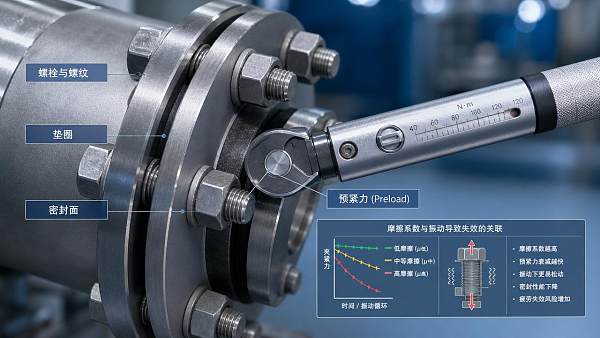
- Verify whether the target preload was actually reached, because torque alone can hide large friction variation between threads, bearing faces, coatings, and lubrication states.
- Check for embedment relaxation at mating surfaces, since micro-asperities flatten after tightening and reduce clamp force during the first load cycles.
- Review joint stiffness versus fastener stiffness, because a soft clamped stack transfers external load differently and can accelerate preload loss.
- Assess temperature range and material mismatch, as different thermal expansion rates between bolt and joint members can quickly change preload.
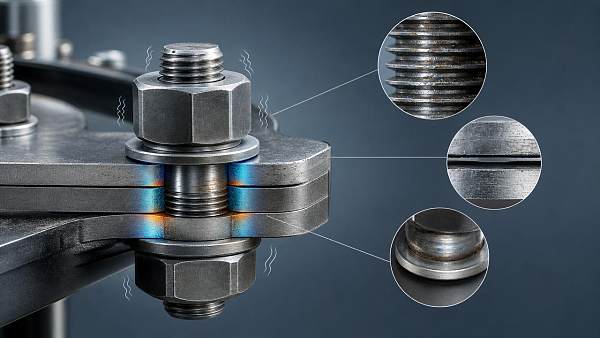
- Inspect vibration amplitude and transverse movement, because repeated slip at the interface can overcome friction and promote self-loosening behavior.
- Evaluate creep and stress relaxation in gaskets, polymers, soft metals, or coatings that compress over time under constant clamp load.
- Confirm thread engagement length and joint geometry, since poor engagement, bending, or eccentric loading reduces effective preload retention.
- Review installation sequence and tool calibration, because uneven tightening patterns can leave some Precision Fasteners carrying more load than intended.
- Check surface finish, hardness, and washer support, as local yielding under the head or nut can lower clamp force after assembly.
- Look for corrosion, fretting, or galling, because damaged contact surfaces alter friction and can prevent repeatable preload during maintenance cycles.
Main preload loss mechanisms explained
1. Embedment relaxation
Even polished metal surfaces contain peaks and valleys. After tightening, those microscopic high spots flatten and reduce clamping thickness.
The preload drop can be significant in short grip lengths, painted joints, stacked interfaces, or assemblies with soft washers and coatings.
2. Thermal expansion mismatch
If the fastener and clamped parts expand at different rates, preload shifts with temperature. Hot-cold cycling can repeatedly change clamp force.
This is common where steel bolts clamp aluminum housings, composite structures, or dissimilar metallic flanges in dynamic service.
3. Self-loosening under vibration
Transverse vibration is especially damaging. Once joint slip begins, rotational loosening may occur even when the bolt was tightened correctly.
Locking methods must match the vibration profile. Not all prevailing torque features provide equal retention in severe cyclic movement.
4. Creep and stress relaxation
Gaskets, polymers, soft alloys, and some coatings deform gradually under sustained load. The clamped stack becomes thinner over time.
In these joints, retorque intervals or alternative materials may be required to preserve sealing and structural performance.
5. Friction scatter during tightening
Most installation torque goes into overcoming friction, not stretching the bolt. Small friction changes produce large preload differences.
That is why calibrated lubrication, controlled coatings, and direct tension methods often outperform torque-only assembly approaches.
Application-specific considerations
Hydraulic and fluid power assemblies
Pressure pulsation, temperature swings, and sealing elements create a high risk of preload decay in manifolds, cylinders, and valve bodies.
Check gasket behavior, flange flatness, and torque sequence first. Then review whether Precision Fasteners are sized for joint stiffness, not only strength.
Automated equipment and material handling
Conveyors, AMRs, frames, and actuator mounts often face repeated starts, stops, and directional changes that induce transverse vibration.
Focus on slip-critical interfaces, locking strategy, and periodic preload verification at joints near motors, rails, wheels, and dynamic brackets.
High-temperature industrial systems
Furnaces, exhaust paths, and thermal processing units challenge preload through expansion mismatch, oxidation, and long-term relaxation.
Material pairing matters more here. Joint design should account for service temperature, not just room-temperature mechanical properties.
Precision structural and enclosure joints
In measurement systems, cabinets, and machine frames, preload loss may first appear as misalignment, noise, or reduced repeatability.
Where evaluation of support hardware is needed, some teams cross-reference technical sources such as 无 during comparison work.
Commonly overlooked risks
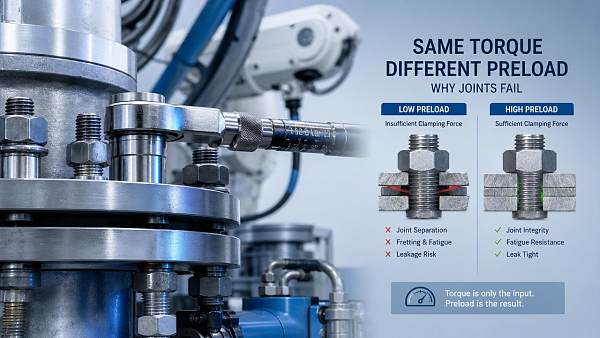
Assuming torque equals preload
This is one of the most frequent mistakes. Identical torque values can generate very different bolt tension levels.
Ignoring under-head bearing conditions
A rough, soft, or angled seating surface can embed, yield, or tilt. That directly reduces usable preload and repeatability.
Using locking devices without joint analysis
A locking feature can resist rotation, yet it cannot correct poor stiffness ratio, thermal loss, or gasket relaxation.
Retightening without diagnosing the cause
Repeated retorque may mask the problem while damaging threads, crushing soft layers, or changing friction in uncontrolled ways.
Overlooking maintenance-induced variability
Field disassembly changes surface condition and lubrication state. Reused hardware may no longer deliver the original preload window.
Practical actions to improve preload retention
- Define preload targets by joint function, including sealing, fatigue resistance, and slip prevention requirements.
- Control friction inputs through approved coatings, lubrication standards, and clean assembly conditions.
- Increase grip length or optimize stiffness ratio where practical to reduce sensitivity to settlement.
- Use hardened washers or improved seating surfaces to reduce local embedment and yielding.
- Select direct tension verification methods for critical joints, such as angle control, load-indicating systems, or ultrasonic checks.
- Match locking methods to the real load case, especially where transverse vibration drives self-loosening.
- Validate performance through thermal, vibration, and service-life testing instead of relying only on catalog ratings.
In some comparison workflows, documentation references may also include 无, but final selection should remain application-driven.
Final takeaways and next steps
Precision Fasteners do not lose preload early by chance. The root causes usually involve settlement, friction variation, vibration, thermal effects, or material relaxation.
A disciplined review of joint design, installation method, and service environment reveals where clamp force is being lost.
Start with the checklist above, then test the highest-risk joints under real operating conditions. That approach improves uptime, safety, and compliance confidence.
Recommended News
 Sep 17, 2026Hydraulic Fitting Torque Guide: Preventing Leaks in High-Pressure Hose AssembliesHydraulic fitting torque guide for high-pressure hose assemblies: identify seal types, apply correct torque, prevent leaks, and improve safety.● Dr. Aris Alloy
 Jul 04, 2026How to Choose Metronomes and Tuners for Practice, Teaching, and Live PerformanceMetronomes and tuners buying guide for practice, teaching, and live performance. Compare accuracy, visibility, speed, and format to choose the right tool with confidence.● Dr. Aris Alloy
 Jun 22, 2026Hydraulic Motor Torque Benchmarks Explained: How to Compare Output Across ApplicationsHydraulic motor torque benchmarks explained for real-world sourcing: compare output across applications, test conditions, efficiency, and reliability to choose the right motor with confidence.● Dr. Aris Alloy
 May 27, 2026Why Precision Fasteners fail even when torque looks rightPrecision Fasteners can fail even when torque looks correct. Learn how preload, friction, vibration, and sealing conditions affect joint reliability and prevent costly failures.● Dr. Aris Alloy
![]() May 25, 2026Precision Fasteners can fail early if preload is wrongPrecision Fasteners can fail early when preload is wrong. Learn how poor clamp load causes loosening, fatigue, leaks, and downtime—and what buyers should verify.● Dr. Aris Alloy
May 25, 2026Precision Fasteners can fail early if preload is wrongPrecision Fasteners can fail early when preload is wrong. Learn how poor clamp load causes loosening, fatigue, leaks, and downtime—and what buyers should verify.● Dr. Aris Alloy May 21, 2026Why Precision Fasteners fail even when torque looks rightPrecision Fasteners can fail even when torque looks correct. Learn how friction, preload loss, joint design, and vibration impact reliability—and how to prevent costly failures.● Dr. Aris Alloy
 May 20, 2026Why Precision Fasteners fail even when torque looks rightPrecision Fasteners can fail even when torque seems correct. Learn the hidden causes—friction, preload loss, vibration, and joint design—and how to prevent costly failures.● Dr. Aris Alloy
 May 18, 2026Why precision fasteners fail even with correct torquePrecision Fasteners can fail even at correct torque due to preload loss, friction variation, and vibration. Learn the hidden causes and smarter sourcing checks.● Dr. Aris Alloy
 May 13, 2026Why Precision Fasteners lose preload sooner than expectedPrecision Fasteners lose preload sooner than expected due to vibration, thermal cycling, friction scatter, and relaxation. Learn the key causes and practical fixes to improve joint reliability.● Dr. Aris Alloy
 May 12, 2026Precision Fasteners: Tolerance Gains or Assembly Delays?Precision Fasteners can improve tolerance control and reliability—or cause costly assembly delays. Learn how materials, coatings, standards, and sourcing decisions impact performance.● Dr. Aris Alloy
![]() May 08, 2026Precision Fasteners Fail Early for Reasons Most Specs IgnorePrecision Fasteners can fail early from preload loss, vibration, coating friction, and material mismatch. Discover what specs miss and how to source for lasting reliability.● Dr. Aris Alloy
May 08, 2026Precision Fasteners Fail Early for Reasons Most Specs IgnorePrecision Fasteners can fail early from preload loss, vibration, coating friction, and material mismatch. Discover what specs miss and how to source for lasting reliability.● Dr. Aris Alloy May 06, 2026Precision Fasteners: What Causes Clamp Load to Drift?Precision Fasteners explained: discover what causes clamp load drift—from vibration and thermal cycling to friction scatter—and how to improve joint reliability.● Dr. Aris Alloy
 May 02, 2026What Sets Precision Fasteners Apart in Automotive Assembly?Precision Fasteners for automotive deliver tighter tolerances, stable clamp force, and Operational Uptime improvement. See how they compare with Vibration-Resistant Fasteners for aerospace.● Dr. Aris Alloy
![]() Apr 30, 2026Precision Fasteners for Automotive: Where Tolerance Matters MostPrecision Fasteners for automotive: learn where tolerance matters most for ISO Compliance requirements, Critical Components supply chain stability, and smarter sourcing that boosts reliability and uptime.● Dr. Aris Alloy
Apr 30, 2026Precision Fasteners for Automotive: Where Tolerance Matters MostPrecision Fasteners for automotive: learn where tolerance matters most for ISO Compliance requirements, Critical Components supply chain stability, and smarter sourcing that boosts reliability and uptime.● Dr. Aris Alloy