Hot Articles
Popular Tags
When Should You Approve a Second-Source Supplier?
Approve a second-source supplier when the risk of relying on your current source justifies the cost of qualification, and the alternative has demonstrated that it can meet your technical, quality, delivery, and compliance requirements. A lower quotation or a successful sample is useful evidence, but neither is enough to authorize routine production supply.
The question “When should I approve a second source supplier?” involves two decisions: when to begin qualification, and when to release the supplier for purchasing. Qualification should begin early enough to finish before a foreseeable disruption. Approval should follow evidence that the supplier can perform within a clearly defined scope.
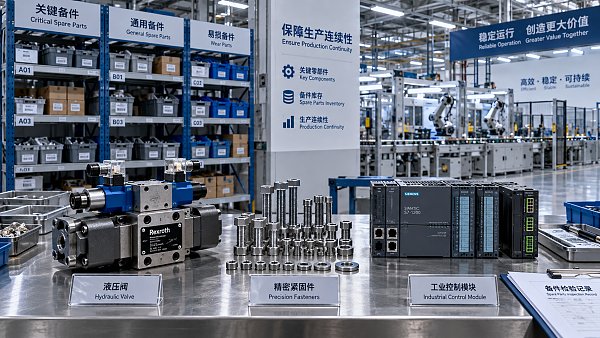
That distinction matters for critical industrial components. A hydraulic assembly that fits correctly may still behave differently under load. A fastener with matching dimensions may have different fatigue characteristics. An automation component may connect physically but require changes to software, safety functions, or maintenance procedures.
When a second source is worth qualifying
The strongest reason to develop an alternative is a mismatch between how long your operation can tolerate an interruption and how long recovery would take. If available inventory would run out before a replacement supplier could be qualified and deliver usable parts, the current sourcing arrangement leaves an exposed gap.
Consider the complete recovery period: finding a candidate, obtaining drawings and samples, conducting tests, securing any required customer acceptance, preparing tooling, scheduling production, and transporting the first shipment. A supplier’s quoted manufacturing lead time covers only part of that sequence.
Repeated delivery failures, unresolved quality problems, constrained capacity, financial instability, and dependence on a vulnerable production location can justify starting qualification. So can planned growth that the incumbent cannot support. A second source may also be commercially useful when price changes, minimum order quantities, or restrictive terms create persistent disadvantages.
However, one late shipment does not automatically justify another supplier. If the cause is understood, corrective action is effective, and recovery fits within your operating buffer, improving the existing arrangement may be the better choice.
Compare dual sourcing with inventory and supplier development
A second supplier is one way to protect continuity, but it is not always the most effective one. The right choice depends on the failure you are trying to absorb.
Additional inventory can cover short interruptions when demand is reasonably predictable and the component stores well. Its limitations include carrying cost, shelf life, preservation requirements, and obsolescence. Inventory also provides only temporary protection against a prolonged shutdown or unresolved quality defect.
Developing the incumbent can work when the supplier has sound technical capability but weak planning, insufficient equipment, or correctable process problems. Capacity reservations, better forecasts, and documented corrective actions may address the root cause. This approach still leaves dependence on that supplier’s site and upstream network.
An approved second source becomes more attractive when interruptions could outlast a practical inventory buffer, demand needs exceed one supplier’s capacity, or recovery depends on resources that are difficult to replace. It also introduces costs: separate tooling, validation, order administration, audits, and potentially smaller volumes at each supplier.
These options can be combined. An inventory buffer can protect operations while a second source is qualified, while continued supplier development improves the performance of both sources.
The evidence that should separate qualification from approval
A supplier can pass an initial review without being ready for routine orders. Approval should connect evidence to the specific component, production site, manufacturing process, and application covered by the decision.
Technical suitability in the actual application
Start with a controlled specification that identifies which characteristics affect fit, function, safety, service life, and interchangeability. Drawings alone may omit operating conditions or assumptions embedded in the incumbent’s design.
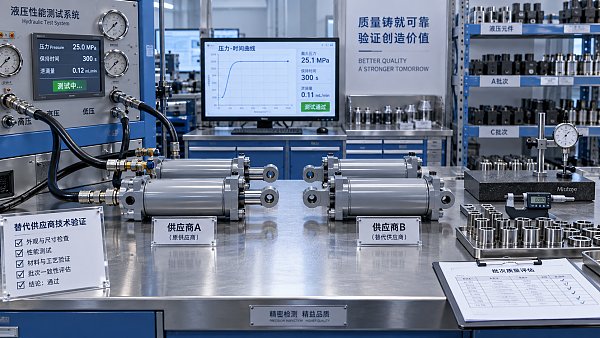
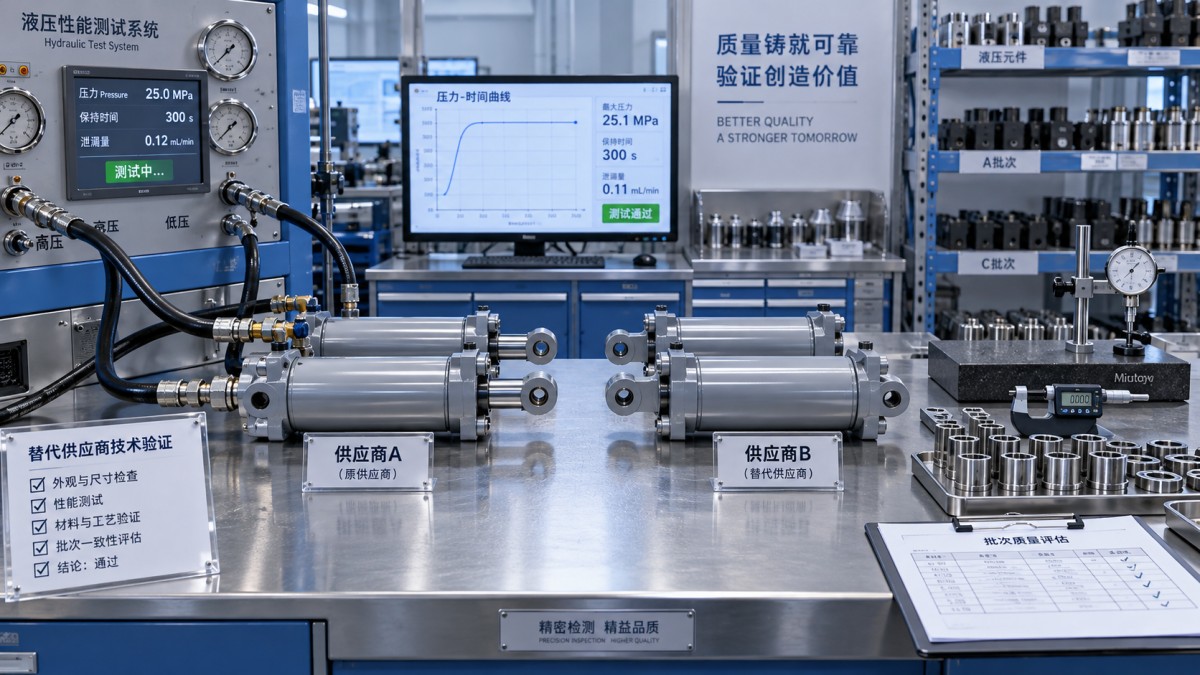
For a hydraulic cylinder, relevant differences can include seal materials, fluid compatibility, surface finish, mounting geometry, leakage behavior, and response under load. For precision fasteners, material condition, thread geometry, heat treatment, coating, and installation friction can affect joint performance even when the nominal size matches.
A flow meter may require evaluation of accuracy across the operating range, fluid properties, pressure loss, installation conditions, and communication behavior. Automation hardware can introduce additional questions about control interfaces, protective functions, spare parts, and software compatibility.
The alternative does not have to be physically identical in every detail. It must satisfy the approved requirements, with any differences assessed and accepted. If substitution changes the equipment design or operating procedure, engineering change control belongs in the approval process.
Repeatable production quality
A good sample demonstrates that the supplier can make a conforming item. It does not establish that normal production will remain consistent.
Review how the supplier controls materials, manufacturing steps, inspection, calibration, nonconforming product, and traceability. For characteristics that are difficult to inspect after manufacture, assess the relevant process controls and validation evidence.
Samples and trial lots should represent the intended production route. Parts made by a development team using exceptional inspection or a different subcontractor may give an overly favorable impression. The evidence should show how production variability is managed and how defects are contained.
A quality management certificate can support the assessment, but its scope matters. It does not establish that a particular part meets its drawing or that a specific production process is suitable.
Capacity that is available when needed
Ask what volume the supplier can commit to, at what lead time, and under which constraints. Installed equipment capacity is different from available capacity after existing customer commitments are considered.
Check tooling readiness, staffing, material availability, subcontracted operations, maintenance coverage, and ramp-up requirements. A supplier able to deliver a small trial lot may still be unable to absorb emergency demand.
Commercial arrangements should support the intended role. A dormant backup needs clear expectations for tooling storage, restart lead time, minimum orders, and reserved capacity. Without those arrangements, an approved name on a supplier list may provide little practical protection.
Applicable compliance and contractual acceptance
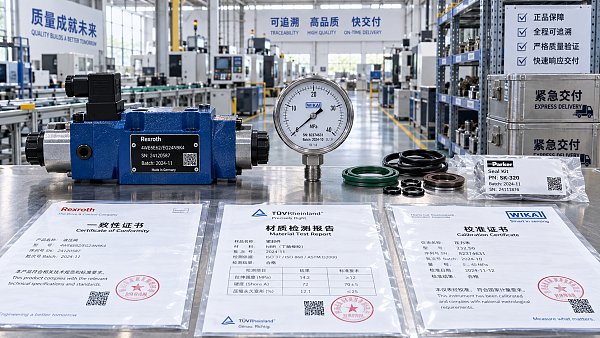
Map the requirements that apply to the component and its end use. These may include material documentation, restricted substances, traceability, testing records, customer approvals, or sector-specific obligations.
Standards should be selected for their relevance to the application. Citing ISO, DIN, ASME, or IEEE broadly does not demonstrate compliance with a particular requirement. The approval record should identify the applicable specifications and the evidence supporting conformity.
Also address ownership of drawings and tooling, access to service documentation, warranty responsibilities, and notification of manufacturing changes. An alternative is difficult to manage if it can change a critical material or subcontractor without notice.
Check whether the alternative actually reduces supply risk
Two suppliers can share the same point of failure. They may buy specialty steel from the same mill, outsource heat treatment to the same facility, depend on one seal manufacturer, or ship through the same constrained route.
Assess independence against the disruption you are concerned about. A nearby alternative may reduce exposure to one factory’s shutdown while offering little protection against a regional interruption. Two distributors may provide different purchasing channels while relying on the same original manufacturer.
Shared upstream resources do not necessarily make the alternative unsuitable. They limit the protection it provides. If the objective is additional assembly capacity, shared raw material supply may be acceptable. If the objective is protection against that material source failing, it leaves the central problem unresolved.
This is where supply-chain intelligence can support qualification. G-ISC’s coverage of critical components, raw materials, and cross-border trade conditions is relevant to identifying exposures beyond the immediate supplier. That information helps frame the assessment; approval still depends on evidence about the actual component and production route.
Choose an approval status that matches the evidence
Approval need not be a single unrestricted decision. Distinguishing development status, limited production authorization, and routine approval makes the scope clearer.
Conditional approval is appropriate when remaining uncertainty can be contained—for example, through additional inspection while production consistency is evaluated. It is inappropriate when a critical requirement remains unresolved and the proposed controls cannot detect or prevent the failure.
A dimension that can be reliably checked on receipt presents a different risk from uncertain fatigue performance or unverified software behavior. The approval decision should reflect that difference.
Approval is not the same as an immediate order split
Once a supplier is approved, decide how it will remain ready. An active second source receives recurring production orders; a standby source is retained for defined contingencies. Neither arrangement is automatically better.
Regular orders help exercise processes, maintain familiarity, and reveal delivery problems before an emergency. They may also reduce purchasing economies and increase administrative effort. Standby sourcing can suit expensive or infrequently used components, provided tooling, documentation, capacity, and restart conditions remain current.
Set the allocation around demand, supplier capability, and the time needed to increase output. Avoid assuming a supplier handling a small share can immediately replace the incumbent’s entire volume. The ramp-up plan should account for material procurement, work in progress, testing, and transport.
Keep qualification current through performance reviews and proportionate revalidation after relevant changes. A move to another factory, a new material source, revised tooling, or a changed manufacturing process can affect the basis of approval.
What to put in the final approval record
A useful approval record should make the decision understandable months later. Capture the business reason for adding the source, approved part numbers and revisions, production location, accepted technical differences, supporting test and inspection evidence, capacity commitments, and applicable customer or regulatory acceptance.
Document any limits, open actions, review dates, and events that trigger reassessment. Engineering should accept technical suitability, quality should accept the production controls, and the relevant operational and commercial functions should accept delivery readiness and purchasing terms.
Begin with the component whose interruption would create the largest recovery gap. Compare its inventory coverage with the time required to qualify and activate an alternative. If that gap is unacceptable, start qualification now. Release production orders when the evidence supports the intended use, and keep the authorization narrow enough that its conditions remain clear.
Recommended News
 Oct 16, 2026How to Use Supply Chain Risk Scores to Screen Suppliers in EuropeNeed a supply chain risk score Europe procurement teams can trust? Learn how to verify suppliers, uncover hidden risks, and build a defensible shortlist before you buy.● Lina Cloud
 Oct 15, 2026Cloud SCM Pricing: How to Compare Uptime SLAs and Downtime CostsCompare SCM cloud uptime pricing, SLA exclusions, downtime costs, and recovery options. Learn how to assess true value, reduce disruption risk, and choose the right cloud SCM plan.● Lina Cloud
 Oct 14, 2026How Do You Identify Supply Chain Risks for Critical Components?How can I identify supply chain risks for critical components? Discover how to map hidden dependencies, compare inventory with recovery time, and prioritize actions that protect uptime.● Lina Cloud
 Oct 14, 2026When Should You Approve a Second-Source Supplier?When should I approve a second source supplier? Discover key checks for quality, capacity, compliance, and supply risk to make confident approvals and protect production.● Lina Cloud
 Oct 11, 2026Predictive Supply Chain Case Studies: Reducing Global Sourcing Disruption RiskPredictive supply chain case studies for global sourcing: uncover disruption risks, protect critical components, and build resilient project delivery.● Lina Cloud
 Oct 03, 2026How to Evaluate Supply Chain Orchestration Software for Multi-Site OperationsSupply chain orchestration software: learn how to evaluate data, workflows, integrations, and governance for resilient multi-site operations.● Lina Cloud
 Oct 01, 2026How Procurement Teams Can Evaluate Supply Chain Risk Management Tools Before BuyingSupply chain risk management tool for procurement: learn how to evaluate data accuracy, part-level impact, alerts, workflows, integrations, and auditability before you buy.● Lina Cloud
 Oct 10, 2026Can Oracle supply planning reduce shortages without raising inventory?Oracle supply planning helps reduce shortages without inflating inventory through smarter allocation, scenario planning, and constraint-based decisions. Discover practical strategies.● Lina Cloud
 Oct 07, 2026What Happens When a Supplier Fails an Industrial Standards Audit?What happens if a supplier fails an industrial standards audit? Learn how to contain risk, protect traceability, manage corrective actions, and maintain supply continuity.● Lina Cloud
 Oct 06, 2026How Do You Document Standards Compliance for a Supplier Tender?How do I document standards compliance for a supplier tender? Use a compliance matrix, traceable test evidence, and clear deviations to strengthen bids and speed evaluation.● Lina Cloud
 Oct 02, 2026Which Supplier Records Should Be Checked Before an Urgent Purchase?Which supplier records should be checked before an urgent industrial purchase? Discover essential checks for quality, traceability, compliance, delivery, and risk control.● Lina Cloud
 Oct 01, 2026How Should Buyers Compare Suppliers Across Industrial Categories?How do I compare suppliers across different industrial categories? Use a practical framework for risk, quality, cost, resilience, and technical fit.● Lina Cloud
 Sep 30, 2026What Should Be Included in a Strategic Sourcing Plan?What should be included in a strategic sourcing plan? Explore essential steps for supplier strategy, total cost, risk control, compliance, and resilient industrial procurement.● Lina Cloud
 Sep 29, 2026How Do Raw Material Prices Affect Industrial Component Lead Times?How do raw material prices affect component lead times? Learn how availability, supplier inventory, and qualification risks shape delivery planning.● Lina Cloud
 Sep 19, 2026How to Evaluate an OEM Supplier for Real-Time Shipment Tracking IntegrationReal time shipment tracking OEM supplier evaluation: compare integration, data accuracy, security, costs, and pilot accountability to protect critical deliveries.● Lina Cloud
 Sep 12, 2026OEM Cooperation Process: Key Milestones for Managing Quality, Costs, and DeliveryOEM cooperation process guide: discover key milestones to control quality, total costs, and delivery risk for stronger, more reliable supplier partnerships.● Lina Cloud
 Aug 25, 2026How to Evaluate a Cloud OMS for OEM Operations with Complex Order WorkflowsEvaluate an order management system OMS OEM cloud platform for complex workflows. Learn what matters most in integration, traceability, scalability, and risk control.● Lina Cloud
 Aug 23, 2026What to Check Before Buying Bridal Tiaras Wholesale for a Retail CollectionBridal tiaras wholesale buying starts with quality, materials, MOQ, and supplier checks. Learn how to reduce risk, protect margins, and build a retail collection that sells.● Lina Cloud
 Aug 22, 2026How to Evaluate Poker Tables Wholesale Suppliers for Quality, MOQ, and CustomizationPoker tables wholesale buying guide: learn how to evaluate suppliers for quality, MOQ, customization, packaging, and lead times to reduce risk and choose scalable partners.● Lina Cloud
 Aug 18, 2026How Can a Supply Chain Digital Twin Improve Procurement Decisions and Supplier Risk?Supply chain digital twin procurement helps buyers compare suppliers, model disruption risk, and improve sourcing decisions with stronger cost, resilience, and performance insight.● Lina Cloud
 Aug 14, 2026What Is Procurement Planning? A Practical Guide for Reducing Buying RiskProcurement Planning helps reduce buying risk by aligning demand, specs, budget, and sourcing strategy. Learn how to buy smarter, avoid delays, and control costs.● Lina Cloud
 Aug 02, 2026How Polymer Raw Materials Affect Sensor Cost, Durability, and Design Trade-OffsImpact of raw material on sensor costs polymers goes far beyond resin price. Learn how polymer choice shapes durability, yield, sealing, and smarter sensor design decisions.● Lina Cloud
 Jul 29, 2026How to Evaluate a Supply Chain Sustainability Tracker Vendor for Reporting NeedsSupply chain sustainability tracker vendor evaluation starts with data integrity, framework mapping, and supplier workflows. Learn how to choose a platform that supports credible reporting and faster procurement decisions.● Lina Cloud
 Jul 28, 2026How Shippers Can Evaluate a Transportation Management System for Cost and Carrier ControlTransportation management system shippers can rely on to cut freight costs, improve carrier control, and boost visibility. Learn what to test before choosing a TMS.● Lina Cloud